
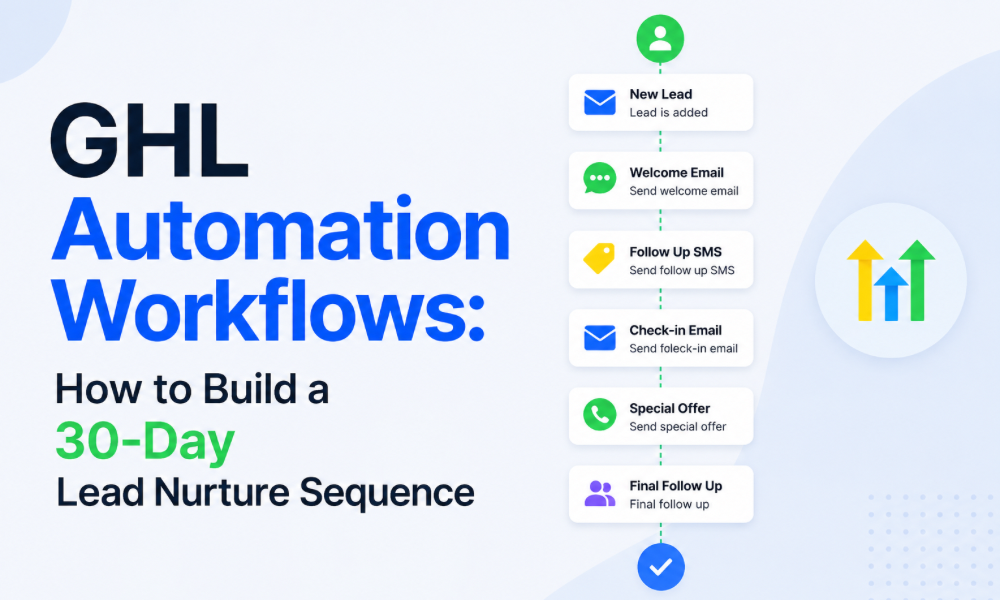
Getting a new lead is exciting, but the first contact is only the beginning of the sales process. Many prospects are not ready to buy the moment they submit a form, download a resource, request information, or respond to an advertisement. They may be comparing providers, researching their options, waiting for approval, or simply trying to understand whether a particular solution is right for them.
This is where a well-designed 30-day lead nurture sequence can make a major difference. Instead of expecting a salesperson to remember every follow-up, GoHighLevel can help businesses create a structured journey that keeps communication consistent while still leaving room for personal interaction.
The important part is not creating 30 days’ worth of messages just to stay in touch. A successful nurture sequence should gradually build trust, answer questions, address objections, demonstrate value, and make the next step easier. The communication should feel useful rather than repetitive.
A business working with a GHL automation specialist can design this journey around its actual sales process instead of simply copying a generic workflow. Companies may also choose to hire gohighlevel consultant support, hire a gohighlevel expert, work with gohighlevel experts Toronto, or build a dedicated gohighlevel expert team when automation becomes an important part of their lead-generation system.
What a 30-Day Nurture Sequence Is Really Designed to Do
A 30-day sequence is not about sending one message every day regardless of what the prospect does. The purpose is to create a flexible communication framework that responds to the lead’s behavior.
Someone who books a meeting on day three should not continue receiving messages designed for people who have never responded. A prospect who replies to an email may need human attention rather than another automated message. Someone who clicks through to a service page repeatedly may deserve a different follow-up path from someone who has shown no engagement.
This means the sequence should include conditions and decision points rather than functioning like a simple calendar.
The first objective is usually establishing contact. The next is building familiarity and relevance. Later stages can focus more heavily on objections, proof, offers, and conversion.
Start With the Trigger, Not the Messages
Before writing any emails or text messages, determine what starts the workflow.
A lead may enter after submitting a website form, requesting a quote, downloading a resource, booking through a landing page, responding to an advertisement, or being manually added by a sales representative.
The trigger matters because it establishes the context of the relationship.
Someone requesting a consultation already has stronger intent than someone downloading a general guide. They should not necessarily receive the same sequence.
A GHL automation specialist can help map these entry points and determine whether different lead sources should enter separate workflows or share a common nurture framework with different branches.
Day 1: Respond While Interest Is Fresh
The first day should focus on acknowledgement and relevance.
When someone provides their information, they should receive confirmation that the business received their request. If appropriate, the message can explain what happens next and provide a useful resource related to the action they just completed.
The tone should be natural. There is no need to overwhelm a new prospect with a long sales pitch immediately after they submit a form.
The objective is simple: demonstrate responsiveness and make the prospect feel that their action mattered.
If the lead has requested a consultation, the message can confirm the next step. If they downloaded a resource, the communication can help them understand how to use it.
Day 2: Establish Why the Business Is Relevant
Once the initial response has been delivered, the next communication can provide more context about the company and its approach.
Instead of saying that the business is “the best,” explain what makes its process useful. Discuss a common customer challenge, explain how the company approaches that challenge, or share a practical insight.
This begins building authority without forcing a sales conversation.
The prospect should gradually develop an understanding of what the business does and why its approach may be worth considering.
Day 3: Address the Problem Behind the Inquiry
People rarely become customers because they simply like a company. They buy because they want a problem solved or an outcome achieved.
The third stage can focus on that problem.
What usually goes wrong? What mistakes do customers make? What should someone consider before choosing a provider? What happens when the issue is ignored?
Useful education makes the nurture sequence more valuable because the prospect receives something they can actually apply.
This also allows the business to demonstrate expertise without relying on exaggerated claims.
Day 4: Let the Prospect Know What to Expect
Uncertainty can prevent people from taking action.
A prospect may wonder what happens after booking a consultation. They may not know how long the process takes, what information they should provide, whether they will receive a proposal, or whether the conversation will feel like a high-pressure sales call.
A nurture message can remove some of this uncertainty.
Explaining the process makes the next step feel safer and more predictable. This can be especially useful for professional services where customers are committing significant time or money.
Day 5: Introduce Proof
At this point, the prospect has received information and context. It can now be useful to demonstrate that the company’s approach has worked for others.
Case studies, customer experiences, before-and-after examples, reviews, or specific project outcomes can provide evidence.
The strongest proof is specific. Rather than simply claiming that customers are satisfied, explain what problem was addressed and what changed as a result.
Social proof should support the story rather than dominate it.
Day 6: Create an Opportunity for Interaction
Automation should not prevent human conversation.
A nurture sequence can invite the prospect to reply with a question, share their situation, or explain what they are currently struggling with.
This creates a transition from automated communication toward a more personal interaction.
When a prospect responds, the workflow should ideally recognize that behavior and adjust future communication. There is little value in continuing to send generic nurture messages to someone who is already engaged in a real conversation.
Day 7: Make the First Conversion Invitation
After a week of useful communication, the sequence can make a clearer invitation.
The call to action might be booking a consultation, requesting an estimate, starting a trial, speaking with a specialist, or taking another meaningful step.
The message should connect the action with the prospect’s problem.
Instead of simply saying “Book now,” explain why the conversation could help them understand their options or move toward a solution.
Week Two: Move From Awareness Toward Evaluation
The second week should gradually become more commercially focused.
The prospect has already received an introduction and some educational information. Now the sequence can help them evaluate whether the business is a suitable choice.
This can include deeper educational content, comparisons, frequently asked questions, service explanations, customer stories, and information about common objections.
The goal is not to repeat the same offer every few days. It is to help the prospect make a more informed decision.
Day 8: Answer a Common Question
Identify a question that sales representatives frequently hear and answer it directly.
This could involve pricing expectations, implementation time, service scope, results, support, contracts, or another concern that regularly delays decisions.
The best nurture content often comes directly from real conversations between sales teams and customers.
Day 9: Explain What Makes the Process Different
If several competitors offer similar services, prospects need a reason to understand the difference.
This message can explain the company’s methodology, communication style, implementation process, technology, expertise, or customer support.
The focus should be on meaningful differentiation rather than empty marketing language.
A strong hire gohighlevel consultant implementation can help organize these messages around different lead segments, so prospects receive information that is relevant to their specific needs.
Day 10: Provide Practical Value
Not every message should ask for something.
Share a checklist, short guide, useful recommendation, or practical framework that helps the prospect make progress.
Giving value without immediately demanding a conversion creates a healthier relationship and can make later calls to action feel more natural.
Day 11: Address a Common Objection
Every industry has reasons prospects hesitate.
They may believe the solution is too expensive, worry about implementation, question whether it will work for their situation, or assume they can solve the problem themselves.
A good nurture sequence addresses these concerns openly.
The objective is not to argue with the prospect. It is to provide context that helps them make a better decision.
Day 12: Show Another Customer Perspective
One case study may not resonate with every prospect.
A second customer story can highlight a different situation, industry, challenge, or outcome. This helps prospects recognize themselves in the examples.
A gohighlevel expert team can build segmented nurture paths where different customer types receive different proof rather than forcing every lead through the same sequence.
Day 13: Encourage a Small Commitment
Not every prospect is ready to become a customer, but they may be willing to take a smaller step.
They might watch a demonstration, read a detailed guide, answer a question, or review a service page.
Micro-commitments can help prospects move forward without feeling pressured into making a major decision immediately.
Day 14: Make Another Clear Offer
At the end of the second week, provide another direct opportunity to take action.
The message should summarize the problem, reinforce the value of the solution, and make the next step obvious.
If the prospect has already demonstrated strong intent, the workflow can route them toward a more direct sales conversation.
If they have remained inactive, they may be better suited to a slower nurture path.
Week Three: Build Confidence and Remove Friction
By the third week, the sequence should focus heavily on confidence.
At this point, prospects who are still engaged may already understand the company’s offering. Their hesitation may be related to risk, timing, price, internal approval, or uncertainty about the process.
The content should therefore help remove those barriers.
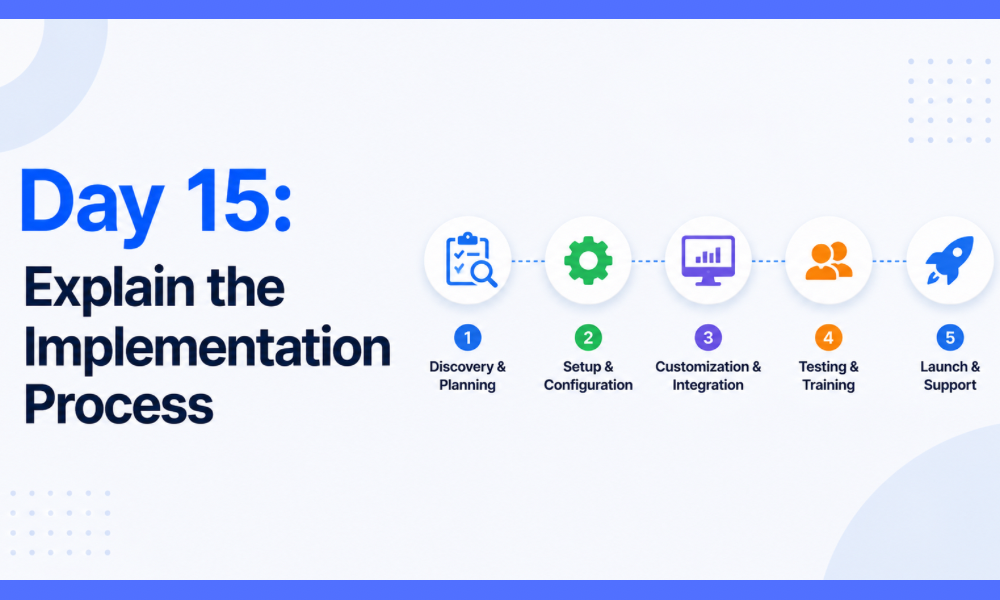
Day 15: Explain the Implementation Process
Customers often worry about what happens after they say yes.
Explain the onboarding process, timeline, communication structure, responsibilities, and major milestones.
When people understand what to expect, the perceived risk of moving forward can decrease.
Day 16: Explain What Happens After the First Conversation
A prospect may hesitate to book because they assume the initial conversation will immediately turn into a hard sales pitch.
Explain what the first meeting actually covers.
This transparency can make booking feel more comfortable and demonstrate confidence in the company’s process.
Day 17: Share a Deeper Educational Resource
Offer something more substantial than a short tip.
This might be an industry guide, detailed article, research summary, case study, or educational video.
The purpose is to reinforce expertise and give the prospect a reason to continue engaging with the company.
Day 18: Highlight a Cost of Inaction
Sometimes customers focus so heavily on the cost of a solution that they overlook the cost of leaving the problem unresolved.
A useful message can help prospects consider the consequences of delay without using fear-based messaging.
What opportunities are being missed? How much employee time is being wasted? What happens if the issue becomes more expensive later?
This can help prospects evaluate the decision from a broader perspective.
Day 19: Make the Business More Human
Automation should still feel human.
Introduce the people behind the business. Share a short story about how the company works, what its team values, or why it approaches customer problems in a particular way.
People often choose businesses they trust, and familiarity contributes to that trust.
Day 20: Revisit the Main Problem
Bring the communication back to the original reason the prospect entered the funnel.
Summarize the problem and connect it with the solution the business provides.
This reinforces relevance without simply repeating previous messages word for word.
Day 21: Offer Direct Assistance
At this stage, a simple message inviting the prospect to ask questions can work well.
The call to action does not have to be aggressive. It can simply communicate that someone is available to help them understand their options.
This is particularly useful for prospects who have been reading but have not yet taken a formal conversion action.
Week Four: Create a Decision Path
The final nine days should not feel like a countdown toward an arbitrary deadline. Instead, the sequence should help the prospect decide what to do next.
Some will be ready to buy. Others will need more time. A few may no longer be interested.
The automation should recognize these differences.
Day 22: Clarify Who the Service Is For
Explain which customers typically benefit most from the solution.
This can help qualified prospects recognize themselves while allowing poor-fit leads to self-identify.
Clear qualification can save time for both the customer and the sales team.
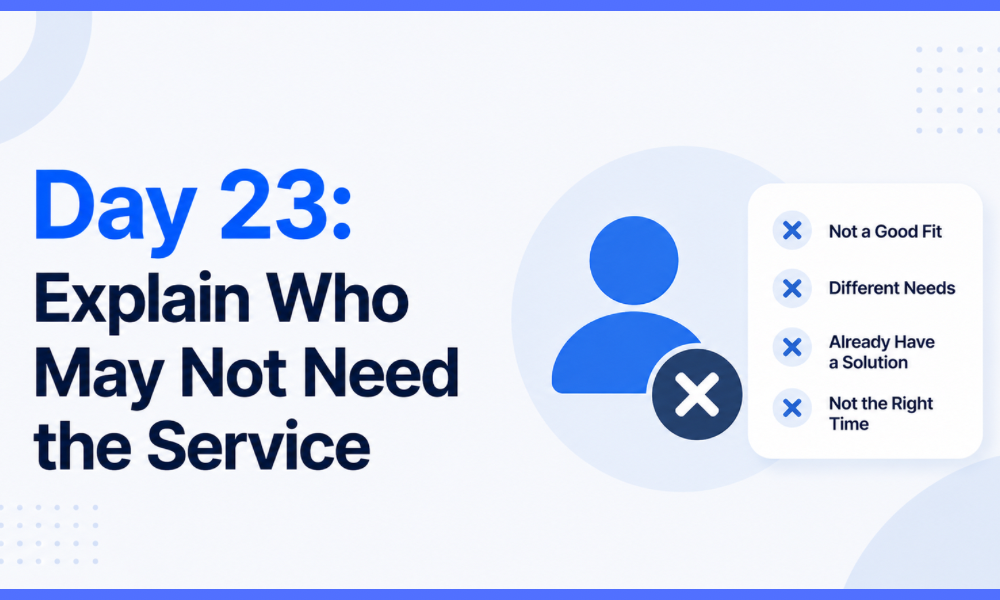
Day 23: Explain Who May Not Need the Service
This can be surprisingly effective.
If there are situations where the company’s service is unnecessary, explaining them demonstrates honesty and confidence.
Prospects are more likely to trust a business that does not claim its solution is perfect for everyone.
Day 24: Share Another Specific Result
Use another piece of proof, preferably one connected to a common prospect situation.
Focus on the problem, the approach, and the outcome rather than making vague claims.
Specificity gives prospects something tangible to evaluate.
Day 25: Address Timing
Some prospects may be interested but believe they should wait.
A message can help them think through whether delaying makes sense and what they can do if they are not ready for a full commitment.
This keeps the conversation open without creating unnecessary pressure.
Day 26: Provide a Final Educational Resource
Offer one more valuable resource related to the prospect’s problem.
This reinforces the idea that the business can continue providing useful information even before a purchase occurs.
Day 27: Make the Main Call to Action
Now the sequence can become more direct.
If the prospect has demonstrated engagement but has not converted, invite them to take the primary next step.
The CTA should be clear, easy to understand, and directly connected to the value the prospect wants.
Day 28: Create a Low-Pressure Reminder
Not everyone responds to a direct offer immediately.A short reminder can acknowledge that the prospect may still be considering their options and provide an easy way to continue the conversation.
This should feel like assistance rather than pressure.
Day 29: Ask What They Need
Instead of sending another sales pitch, ask a simple question.
What is stopping them from moving forward?
What information would help?
Are they still considering the solution?
This can create useful responses that sales teams can act on while also giving the automation valuable behavioral information.
Day 30: Decide What Happens Next
The end of the 30-day sequence should not mean the relationship ends.
Highly engaged prospects can be moved into a sales-focused workflow.
Customers should enter onboarding or retention processes.
People who are interested but not ready can move into a longer-term nurture campaign.
Contacts who have shown no meaningful engagement may receive fewer communications.
The important thing is avoiding the common mistake of allowing every lead to remain trapped in the same workflow indefinitely.