
GoHighLevel can look straightforward when you first open the platform. There are pipelines, calendars, funnels, workflows, forms, campaigns, conversations, and customer records, all available in a single environment. But having access to these features does not automatically mean a business knows how to connect them into a system that actually improves sales and marketing.
This is where a GoHighLevel expert becomes valuable.
A GoHighLevel expert is someone who understands not only how individual features work but also how those features should be configured to align with a company’s customer journey. The right professional can help organize CRM data, build funnels, connect lead sources, automate follow-up, improve appointment processes, structure pipelines, and troubleshoot workflows that are not performing as expected.
The difference becomes particularly important when businesses begin using GoHighLevel at scale. A few simple workflows may be manageable internally, but complicated lead journeys, multiple campaigns, client accounts, SaaS offerings, and industry-specific requirements can quickly create a system that is difficult to maintain.
Whether you are evaluating gohighlevel marketing agencies, exploring gohighlevel saas automation, considering a go high level freelancer, researching ghl for real estate, or looking for professional gohighlevel crm services, choosing the right expertise can determine whether the platform becomes a growth engine or simply another piece of software your team struggles to use.
A GoHighLevel Expert Is More Than Someone Who Knows the Platform
Knowing where to click inside GoHighLevel is only one part of being an expert. The more important skill is understanding why a particular configuration should be used.
For example, a business may want to automate lead follow-up. An inexperienced user might immediately create a sequence of emails and text messages. An experienced professional will first ask where the lead came from, what information was collected, whether the lead is qualified, what happens if the person responds, what happens if they book, and when the automation should stop.
That difference separates platform knowledge from implementation expertise.
A strong GoHighLevel professional thinks about the entire customer journey rather than isolated features. They understand that automation, CRM structure, communication, funnels, appointments, and reporting should work together.
What Does a GoHighLevel Expert Actually Do?
The responsibilities of a GoHighLevel expert can vary considerably depending on the business. Some professionals specialize in CRM implementation, while others focus heavily on funnels, automation, SaaS configuration, or specific industries.
A typical project may involve auditing an existing account, organizing contacts, creating pipeline stages, configuring custom fields, building workflows, connecting forms and calendars, setting up communication sequences, testing automations, and documenting how the system should be used.
The expert may also identify processes that should not be automated. Not every customer interaction should become a workflow. Some situations require personal communication, sales judgment, or human support.
The best implementation combines automation with human involvement rather than attempting to replace every employee action.

CRM Implementation Is Often the Starting Point
A business can have thousands of contacts inside GoHighLevel and still have a poorly organized CRM. Duplicate records, inconsistent tags, unclear pipeline stages, and missing customer information can make the system difficult to use.
Professional gohighlevel crm services focus on creating a structure that reflects how the company actually manages prospects and customers.
This may involve defining lifecycle stages, organizing contact information, establishing naming conventions, separating prospects from customers, and creating clear rules for moving opportunities through the sales pipeline.
A good CRM setup should answer basic questions quickly. Where did this lead come from? What does the prospect need? Who owns the opportunity? What happened during the last interaction? What should happen next?
When those answers are easy to find, the CRM becomes genuinely useful.
Automation Should Follow Strategy
Automation is one of GoHighLevel’s biggest attractions, but it is also one of the easiest areas to misuse.
Businesses sometimes automate processes simply because they can. They create numerous workflows, triggers, conditions, notifications, emails, and messages without first mapping the customer journey.
This can result in conflicting workflows and confusing customer experiences.
A professional expert approaches automation differently. They identify repetitive processes that consume employee time, determine which customer actions should trigger responses, and establish clear conditions for starting and stopping workflows.
For companies exploring gohighlevel saas automation, this becomes even more important because the system may need to support multiple clients or customer accounts. A workflow that works perfectly for one business may not be appropriate for another.
Funnel Knowledge Matters Too
GoHighLevel is widely used for building lead-generation and sales funnels, but a funnel should never be treated simply as a collection of pages.
A good funnel has a purpose. It should move a visitor from initial awareness toward a clearly defined action.
The expert needs to understand the offer, audience, traffic source, messaging, landing-page structure, forms, appointment process, and follow-up journey. A technically perfect funnel can still perform poorly if the offer does not match what the audience wants.
This is why businesses should evaluate whether a potential expert understands conversion strategy as well as GoHighLevel’s technical features.
Industry Experience Can Make a Significant Difference
Different industries have different customer journeys.
A marketing agency may need lead qualification, consultation booking, client onboarding, and reporting workflows. A home service business may require appointment scheduling, location-based routing, missed-call follow-up, and review requests.
Real estate businesses have another set of requirements.
The sales cycle can involve property inquiries, buyer and seller leads, appointments, property preferences, long follow-up periods, and repeated communication. Businesses exploring GHL for real estate should therefore look for professionals who understand how real estate prospects move from inquiry to viewing, negotiation, and eventual transaction.
Industry experience does not mean the expert should force a standard template onto the business. Instead, it means they can recognize common challenges faster and design solutions around the industry’s actual customer behavior.
Agencies May Need a Different Type of Expert
Businesses that operate as marketing agencies often have more complicated GoHighLevel requirements because they may manage systems for multiple clients.
This is where gohighlevel marketing agencies can benefit from specialized expertise. An agency may need reusable workflows, standardized onboarding processes, account structures, reporting systems, client-specific customizations, and efficient maintenance procedures.
The expert must understand not only how to build individual solutions but also how to create systems that can be duplicated and adapted without introducing unnecessary complexity.
Scalability becomes a major consideration.

Freelancer or Dedicated Expert?
A go high level freelancer can be an excellent choice for smaller projects, specific technical tasks, or businesses that need occasional assistance. Freelancers may offer flexibility and can be particularly useful when the scope of work is clearly defined.
However, a freelancer may not always be the right fit for a larger implementation. Businesses managing multiple accounts, complex automations, ongoing optimization, or significant CRM infrastructure may benefit from a dedicated specialist or team.
The decision should be based on project complexity rather than simply comparing hourly rates.
A business should ask how much ongoing support it expects to need, how critical the CRM is to daily operations, and how quickly problems need to be resolved.
Look at Practical Experience, Not Just Certifications
When evaluating a GoHighLevel professional, businesses should look beyond certificates or impressive titles.
Ask what they have actually built.
Have they created complex workflows? Have they managed CRM migrations? Have they built appointment systems? Do they understand funnel optimization? Can they troubleshoot automation conflicts? Have they worked with businesses similar to yours?
A strong professional should be able to explain previous projects in practical terms and demonstrate how their work solved real business problems.
The ability to explain technical decisions clearly is also a positive sign. If someone can build a complicated system but cannot explain why it is structured that way, maintaining the system later may become difficult.
Ask for a Clear Implementation Process
Before hiring an expert, businesses should understand how the project will be handled.
A professional process may begin with discovery and account auditing, followed by strategy development, CRM architecture, workflow creation, testing, launch, and ongoing optimization.
This structure reduces the risk of important details being overlooked.
Businesses should also understand what information the expert needs from them. Customer journey details, sales processes, communication preferences, existing integrations, and business rules all influence the final implementation.
The more clearly both sides define responsibilities, the smoother the project becomes.
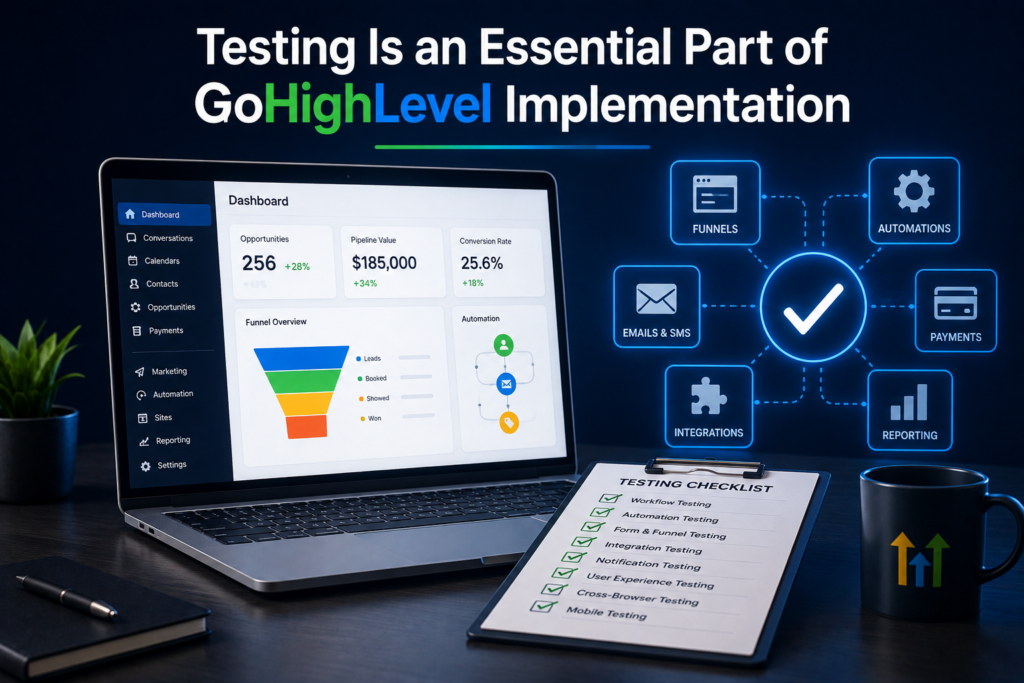
Testing Is an Essential Part of GoHighLevel Implementation
Automations should never be considered finished simply because they have been created.
Every workflow needs testing.
A form submission should trigger the expected action. A booked appointment should stop inappropriate follow-up. A cancellation should update the customer journey correctly. A response should prevent unnecessary messages. Pipeline changes should trigger the correct internal actions.
Testing should include unusual scenarios as well as normal ones.
A strong expert understands that automation errors often become visible only when customers interact with the system in unexpected ways. Thorough testing protects both the customer experience and the business’s reputation.
Ask How the Expert Handles Documentation
A business should not become completely dependent on one individual who knows how its GoHighLevel account works.
Documentation creates continuity.
Important workflows, pipeline structures, naming conventions, integrations, triggers, and business rules should be documented so that another qualified person can understand the system when necessary.
This is especially important for businesses using gohighlevel crm services as a central part of their sales and marketing operations.
Good documentation also makes employee training easier and reduces the risk of accidental changes breaking critical workflows.
Consider Ongoing Optimization
GoHighLevel implementation should not necessarily end when the initial project is completed.
As businesses generate more leads, they learn more about customer behavior. Some workflows may need refinement. New campaigns may require additional automation. Pipeline stages may evolve. New services may need separate funnels.
An expert who provides ongoing optimization can help the system evolve with the business.
This is particularly valuable for organizations using gohighlevel saas automation, where the system may become an important component of a larger recurring-revenue operation.
Watch for Experts Who Promise Too Much
One warning sign is a professional who guarantees extraordinary results without asking enough questions.
GoHighLevel can improve operational efficiency, automate follow-up, and organize marketing processes, but software does not automatically fix a weak offer, poor messaging, insufficient traffic, or an ineffective sales process.
An expert should explain what the platform can realistically accomplish and identify which outcomes depend on other parts of the business.
Honesty is often more valuable than impressive promises.
Understand the Difference Between Building and Improving
Some businesses need a completely new GoHighLevel environment. Others already have an account but are using only a fraction of its capabilities.
In the second situation, rebuilding everything may be unnecessary.
An experienced professional should be able to audit the existing setup and determine what can be improved, removed, reorganized, or retained.
This can save time and prevent businesses from throwing away useful data or workflows simply because the existing system is untidy.
The Right Expert Should Understand Your Business Goals
Ultimately, hiring a GoHighLevel expert is not really about hiring someone to configure software.
It is about hiring someone who can translate business processes into a system that supports growth.
If the goal is to increase booked appointments, the expert should understand the entire journey from lead generation to attendance.
If the goal is to launch a SaaS offering, gohighlevel saas automation may require a different implementation approach.
If the business is an agency, the expert needs to understand client management and scalable account structures.
If the business operates in real estate, GHL for real estate may require workflows designed around longer sales cycles and property-related inquiries.
The platform remains the same, but the implementation should change according to the business.

How to Evaluate a GoHighLevel Expert Before Hiring
Finding someone who understands GoHighLevel is relatively easy. Finding someone who understands how to use it to solve your specific business problems is much harder. Before hiring anyone, businesses should evaluate how the person thinks, communicates, and approaches implementation rather than judging them only by the number of features they claim to know.
A strong expert should be able to look at your current marketing and sales process and explain where GoHighLevel can create the most value. They should also be comfortable telling you when automation is unnecessary or when an existing process needs to be changed before technology can improve it.
Ask About Previous GoHighLevel Projects
Experience becomes much easier to evaluate when it is connected to actual projects. Instead of simply asking whether someone has used GoHighLevel, ask what they have built with it.
A professional may have created lead-generation funnels, appointment booking systems, CRM pipelines, nurture campaigns, client onboarding processes, review workflows, or complex integrations. The important thing is whether those projects are similar enough to your requirements to provide useful experience.
Businesses considering gohighlevel marketing agencies should ask for examples of previous work and, where possible, understand the business problem behind each project. A portfolio showing attractive funnels is useful, but knowing how those funnels supported lead generation and conversion provides much more valuable information.
Look for Strong Problem-Solving Skills
GoHighLevel projects rarely remain exactly as originally planned. A workflow may conflict with another automation. A client may change the qualification process. A form may collect information differently than expected. An integration may stop passing data correctly.
These situations require problem-solving rather than simple platform knowledge.
A good expert investigates the cause before changing random settings. They understand triggers, conditions, actions, dependencies, and the customer journey well enough to identify where a problem originates.
This becomes particularly important when managing complex gohighlevel crm services, because one small change can sometimes affect multiple parts of a connected system.
Pay Attention to How They Explain Technical Concepts
You should not need to be a GoHighLevel specialist to understand what your expert is doing.
A professional should be able to explain complicated workflows in straightforward language. If they recommend a particular automation, they should explain what triggers it, what happens next, why it is useful, and under what circumstances it stops.
Clear communication also makes future maintenance easier. Your internal team should understand the basic logic of the system even if they are not responsible for building it.
An expert who communicates clearly is often easier to work with than someone who uses technical terminology to make a relatively simple solution sound complicated.