
GoHighLevel Lead Nurture Automation: A 7-Day Follow-Up Sequence That Books Calls
Generating leads is only the first step in growing a successful business. What happens after a lead enters your CRM often determines whether that prospect becomes a paying client or disappears forever. Many businesses spend thousands of dollars on advertising and lead generation but fail to implement a structured follow-up system. As a result, qualified prospects lose interest, competitors step in, and valuable opportunities are lost.
Research consistently shows that most leads are not ready to book a sales call immediately after their first interaction with a business. They need education, reassurance, trust, and multiple touchpoints before making a decision. This is why lead nurturing has become one of the most important components of modern sales and marketing.
GoHighLevel provides businesses with the tools needed to automate this entire process. With the right go high level automation strategy, companies can stay connected with prospects, build credibility, answer objections, and encourage appointments without requiring constant manual follow-up.
Whether you are a marketing agency, consultant, coach, SaaS company, or local service provider, implementing a structured 7-day follow-up sequence can significantly increase booked appointments and improve conversion rates. Businesses that work with an experienced Automation Specialist often discover that even small improvements in their nurturing process produce substantial increases in revenue.
Why Most Leads Never Book a Call
One of the biggest misconceptions in sales is that leads fail to convert because they are not interested.
In reality, many prospects simply are not ready to take immediate action.
Some are comparing providers.
Others are researching solutions.
Many are still trying to understand whether your business is the right fit.
Without consistent communication, these leads gradually lose interest or choose another provider who stayed engaged throughout the buying journey.
This is why GoHighLevel marketing focuses heavily on relationship building rather than immediate selling.
A properly designed nurture sequence keeps your business visible while gradually increasing customer confidence.
Instead of pressuring prospects to book a call immediately, the sequence provides value, builds trust, and helps them move naturally toward a purchasing decision.
Businesses that consistently nurture leads often outperform competitors even when generating fewer inquiries because their follow-up process is significantly stronger.
Why Seven Days Is the Perfect Starting Point
Many businesses either stop following up too early or continue sending repetitive messages for weeks without a clear strategy.
A seven-day sequence provides an excellent balance.
It keeps communication consistent during the period when prospects are most engaged while avoiding communication fatigue.
Each day serves a specific purpose within the customer journey.
The goal is not simply sending seven messages.
The goal is guiding prospects through seven meaningful interactions that build familiarity and confidence.
A professional Automation Specialist will often structure these sequences around customer psychology rather than arbitrary timing.
Every message should move the relationship forward.
Every interaction should provide value.
Every communication should create another opportunity for the prospect to engage.
This strategic progression is what makes automated nurturing so effective.
Day One Should Focus on Immediate Engagement
The first few minutes after a lead submits a form or requests information are often the most important.
Interest is at its highest.
Questions are fresh.
Attention is focused.
This is the ideal moment to initiate communication.
With go high level automation, businesses can immediately send a personalized email or SMS thanking the prospect for their interest while explaining what happens next.
Rather than delivering a generic confirmation message, the communication should establish expectations, reinforce value, and begin building trust.
Quick responses demonstrate professionalism while reducing the likelihood that prospects will continue searching for alternatives.
The first impression often determines whether the relationship progresses.
Day Two Should Build Credibility
Once initial contact has been established, the next objective is strengthening trust.
Prospects want reassurance that they are speaking with a knowledgeable and reliable business.
The second day’s communication should focus on demonstrating expertise through educational content, customer success stories, testimonials, or industry insights.
Businesses that implement effective goHighLevel marketing strategies understand that trust grows when customers see evidence rather than promises.
Educational resources position the company as a helpful advisor rather than simply another vendor seeking a sale.
The more value provided during this stage, the more comfortable prospects become with continuing the conversation.
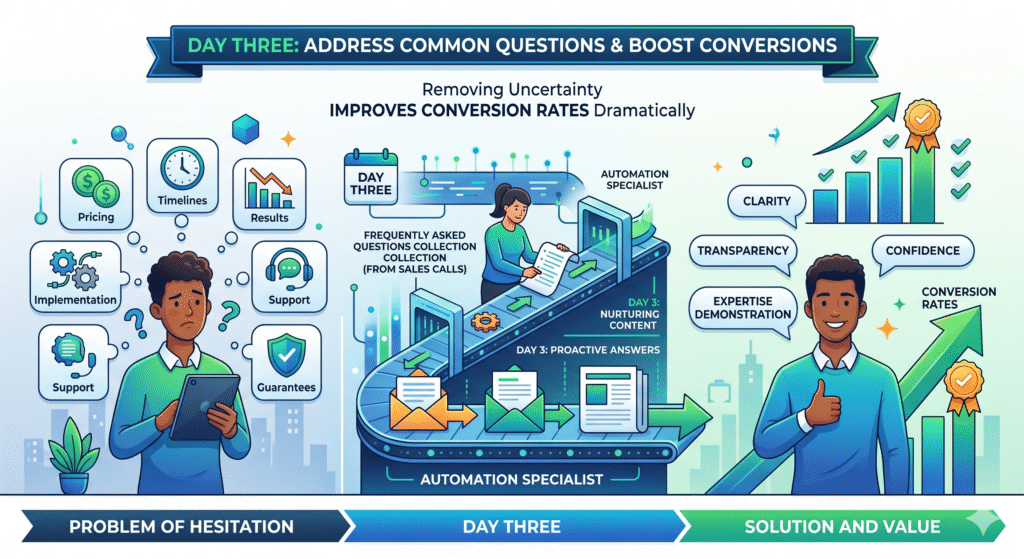
Day Three Should Address Common Questions
Every industry has common customer concerns.
Pricing.
Timelines.
Results.
Implementation.
Support.
Guarantees.
The third day provides an excellent opportunity to proactively answer these questions before prospects even ask them.
Businesses frequently discover that removing uncertainty dramatically improves conversion rates.
An experienced Automation Specialist often creates nurturing content based on frequently asked questions collected from previous sales conversations.
Addressing objections early reduces hesitation while demonstrating transparency and expertise.
Prospects appreciate businesses that anticipate their concerns rather than waiting until the sales call.
Day Four Should Reinforce the Value of Taking Action
Many prospects delay decisions simply because there is no compelling reason to act now.
The fourth day should gently reinforce the benefits of moving forward.
Rather than creating artificial urgency, businesses should focus on the positive outcomes customers can achieve by taking action.
This communication may include additional educational insights, case studies, implementation examples, or explanations of how the business solves specific problems.
The objective is to help prospects visualize success.
Strong go high level automation systems deliver these messages automatically while maintaining personalization and consistency.
Day Five Should Create Social Proof and Reduce Purchase Anxiety
By the fifth day of your lead nurture sequence, prospects have likely interacted with several pieces of communication. They may have opened emails, clicked on links, visited your website again, or explored your services. However, many leads still hesitate to schedule a consultation because they are uncertain whether your business is the right choice. This hesitation is perfectly normal. Before making a commitment, people naturally look for reassurance from others who have already experienced success.
This is where social proof becomes one of the most powerful tools in your nurturing strategy. Instead of focusing on your company, focus on your customers. Share success stories, testimonials, case studies, video reviews, before-and-after results, or measurable business outcomes that demonstrate the value of your services.
For example, rather than saying your agency generates great results, show how one client increased qualified leads, improved conversion rates, or reduced customer acquisition costs after working with your team. Authentic examples build far more confidence than promotional messaging.
Businesses implementing goHighLevel marketing strategies often automate these trust-building assets within their nurture campaigns. As prospects continue moving through the sequence, they begin seeing consistent evidence that your business has successfully helped companies similar to theirs.
An experienced Automation Specialist understands that customer confidence grows gradually. Every testimonial, review, and case study helps remove uncertainty while reinforcing credibility. By Day Five, prospects should begin feeling that working with your company is a logical next step rather than a risky decision.
Day Six: Should Personalize the Conversation
One of the biggest mistakes businesses make with automation is allowing every lead to receive exactly the same communication regardless of their behavior.
Modern customers expect personalization.
Fortunately, GoHighLevel provides numerous ways to create highly personalized experiences using behavioral triggers, CRM data, tags, and segmentation.
By the sixth day, your automation should begin adapting based on how the lead has interacted with previous communication.
For example, prospects who have opened multiple emails may receive a different follow-up than those who have ignored earlier messages.
Visitors who repeatedly view pricing pages may receive educational content focused on return on investment.
Leads who downloaded a resource but never scheduled a consultation may receive additional information addressing common buying concerns.
This is where advanced go high level automation becomes incredibly valuable.
Instead of treating every prospect identically, businesses can create intelligent customer journeys that respond to real engagement.
An experienced Automation Specialist often builds conditional workflows that automatically change communication based on customer actions.
This creates a far more natural experience because prospects receive information that matches their current level of interest.
Personalization also helps businesses avoid one of the biggest weaknesses of traditional automation—generic messaging.
Customers respond far more positively when communication reflects their behavior rather than following a rigid schedule.
Day Seven Should Focus on Booking the Call
The final day of the initial nurture sequence should have one clear objective: encouraging the prospect to schedule a conversation.
By this stage, the lead has already received educational content, customer success stories, valuable insights, and multiple trust-building interactions.
Rather than aggressively pushing for a sale, Day Seven should position the consultation as an opportunity to receive personalized guidance.
Businesses should emphasize the value of the conversation itself.
Explain what the prospect will learn.
Describe how the meeting will help identify opportunities.
Clarify that the consultation is designed to provide solutions rather than sales pressure.
Many businesses using go high level automation integrate calendar booking directly into this stage, making it as easy as possible for prospects to schedule a convenient time.
Removing unnecessary friction dramatically improves booking rates.
The fewer steps required to schedule a meeting, the more likely prospects are to take action.
A well-designed final message should create confidence while making the next step feel simple and worthwhile.
Why Multi-Channel Follow-Up Produces Better Results
Many businesses rely entirely on email when nurturing leads.
While email remains highly effective, modern buyers interact with businesses across multiple communication channels.
Combining email, SMS, voicemail drops, and occasional phone calls often creates significantly stronger engagement than relying on a single method.
GoHighLevel makes this process remarkably efficient by allowing businesses to coordinate communication across multiple channels from one centralized platform.
For example, an email may introduce valuable educational content while an SMS reminds the prospect about a helpful resource.
A voicemail drop can add a personal touch without requiring manual outreach.
Businesses implementing advanced goHighLevel marketing strategies frequently discover that multi-channel communication keeps their brand top of mind while accommodating different customer preferences.
Some prospects respond better to email.
Others prefer text messages.
Some appreciate direct phone communication.
A diversified communication strategy ensures businesses remain accessible regardless of how prospects prefer to engage.
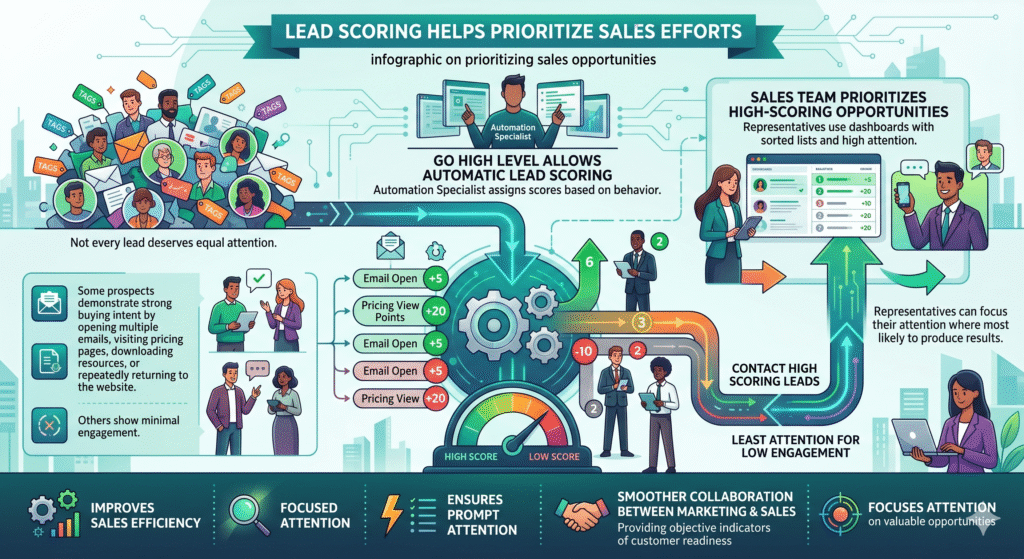
Lead Scoring Helps Prioritize Sales Efforts
Not every lead within a nurture sequence deserves the same level of attention.
Some prospects demonstrate strong buying intent by opening multiple emails, visiting pricing pages, downloading resources, or repeatedly returning to the website.
Others show minimal engagement.
GoHighLevel allows businesses to implement lead scoring systems that automatically identify highly engaged prospects.
An experienced Automation Specialist can assign scores based on customer behavior, allowing sales teams to prioritize opportunities with the greatest likelihood of conversion.
Rather than contacting every lead equally, representatives can focus their attention where it is most likely to produce results.
This improves sales efficiency while ensuring valuable opportunities receive prompt attention.
Lead scoring also creates smoother collaboration between marketing and sales by providing objective indicators of customer readiness.
Integrating White-Label SaaS Into Your Follow-Up Strategy
For agencies using GoHighLevel, lead nurturing can become even more valuable when combined with White-Label SaaS offerings.
Rather than simply selling marketing services, agencies can use their nurture sequence to educate prospects about the long-term value of an integrated software platform.
Emails may demonstrate how clients manage leads, automate communication, monitor pipelines, and improve operational efficiency using the agency’s branded platform.
This approach positions the agency as both a service provider and a technology partner.
Businesses interested in recurring revenue often incorporate software demonstrations and educational content into their nurturing campaigns.
Over time, prospects begin recognizing the broader value of the solution rather than evaluating services based solely on price.
This creates stronger differentiation while increasing customer lifetime value.
Why Businesses Should Continuously Optimize Their Nurture Sequences
One of the biggest misconceptions about marketing automation is that workflows can be created once and left unchanged indefinitely.
Customer behavior changes.
Markets evolve.
Messaging effectiveness shifts.
Competition increases.
For these reasons, every nurture sequence should be treated as an evolving system rather than a completed project.
Businesses should regularly review:
Email open rates.
Click-through rates.
SMS engagement.
Appointment bookings.
Reply rates.
Pipeline movement.
Conversion percentages.
These metrics help identify opportunities for improvement.
Perhaps subject lines need refinement.
Maybe appointment requests are introduced too early.
Perhaps educational content could better address customer concerns.
An experienced Automation Specialist continuously analyzes performance data to improve every stage of the customer journey.
Even small optimizations can produce meaningful increases in appointment bookings over time.
Why GHL Migration Is the Perfect Opportunity to Improve Lead Nurturing
Many businesses move to GoHighLevel because they want more advanced automation capabilities than their existing CRM provides.
A GHL Migration should never involve simply recreating old workflows inside a new platform.
Instead, migration creates an ideal opportunity to redesign and improve lead nurturing strategies.
Businesses can eliminate outdated automation, simplify customer journeys, improve segmentation, strengthen communication timing, and introduce multi-channel engagement.
Rather than transferring inefficient systems, organizations should use migration as an opportunity to build better ones.
Many companies discover that simply restructuring their follow-up process during GHL Migration leads to immediate improvements in appointment booking rates and customer engagement.
Migration becomes not only a technology upgrade but also a marketing optimization project.