
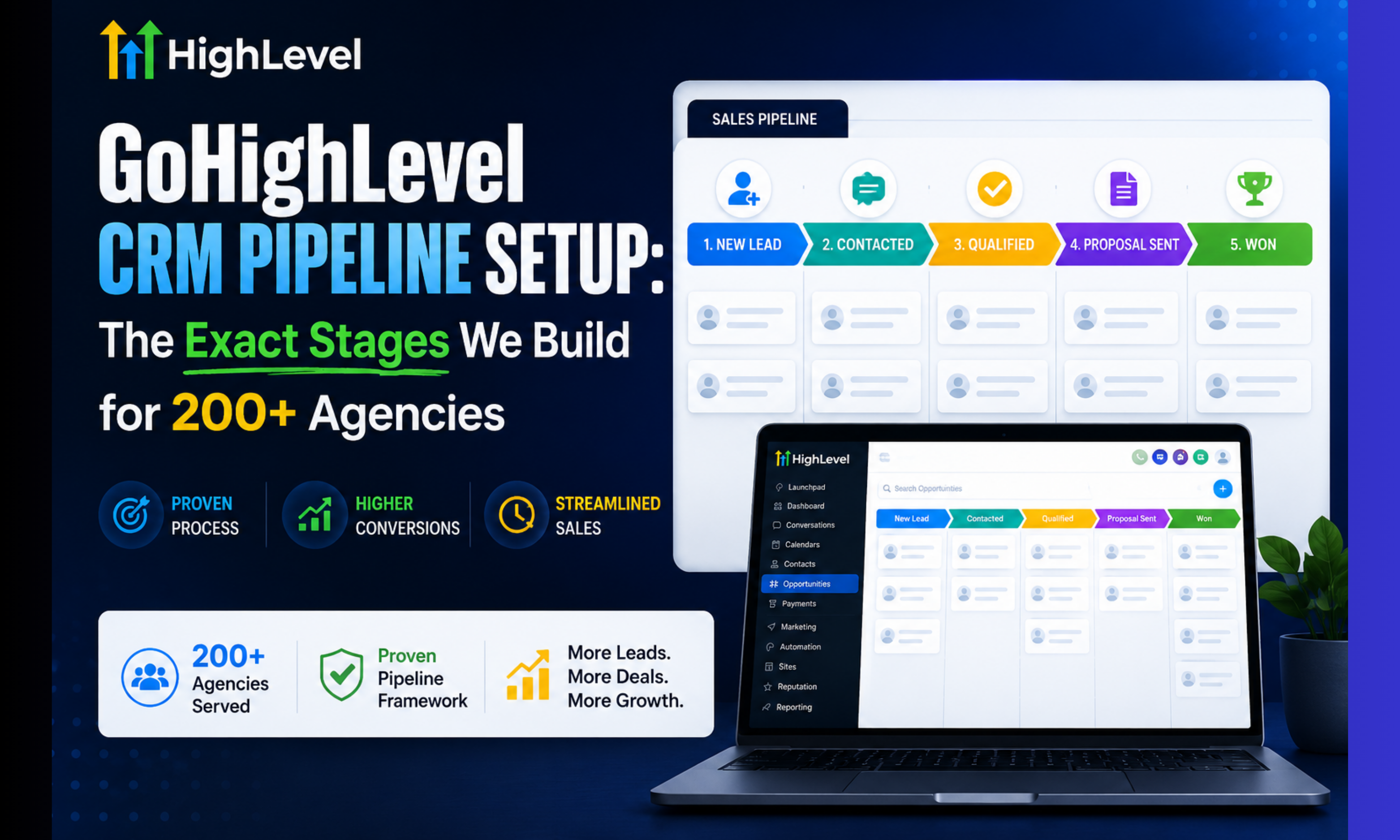
GoHighLevel CRM Pipeline Setup: The Exact Stages We Build for 200+ Agencies
A CRM is only as effective as the pipeline that powers it. Many agencies invest in GoHighLevel expecting better lead management, improved sales visibility, and higher conversion rates, only to discover that their CRM quickly becomes cluttered, disorganized, and difficult to manage.
The problem is rarely the platform itself. In most cases, agencies struggle because their pipeline stages are either too simplistic, too complicated, or completely disconnected from their actual sales process.
A well-structured GHL CRM setup provides clarity at every stage of the customer journey. It allows teams to understand where leads are coming from, how opportunities are progressing, and what actions are required to move prospects closer to becoming clients.
After working with hundreds of agencies, one pattern becomes clear: the highest-performing agencies are not necessarily generating more leads. They are managing leads more effectively through structured CRM systems, intelligent automation, and clearly defined sales pipelines.
This article breaks down the CRM pipeline framework commonly used by successful agencies and explains how each stage contributes to better lead management, stronger follow-up processes, and higher conversions.
Why Most Agency Pipelines Fail
Many agencies build pipelines based on assumptions rather than actual customer behavior.
A common mistake is creating only three or four stages, such as New Lead, Contacted, Proposal Sent, and Won. While simple, these pipelines often fail to provide meaningful visibility into the sales process.
Other agencies make the opposite mistake by creating dozens of stages that are difficult to manage and are rarely updated consistently.
The goal of a successful GHL CRM setup is to provide sufficient visibility into the sales process without overwhelming the team with unnecessary complexity.
When pipeline stages accurately reflect how prospects move through the buying journey, agencies gain better forecasting capabilities, improved accountability, and stronger operational efficiency.
This becomes even more important when Gohighlevel automation workflows are connected directly to pipeline movement.
Stage 1: New Lead
Every opportunity begins here.
The New Lead stage captures prospects immediately after they enter the system through websites, landing pages, advertisements, referrals, social media campaigns, or other lead-generation channels.
At this stage, the objective is not to sell.
The objective is speed.
Research consistently shows that faster response times significantly improve conversion rates.
Many agencies use Gohighlevel automation to trigger immediate responses through email, SMS, or voicemail drops as soon as a lead enters the CRM.
This ensures every inquiry receives prompt attention while creating a strong first impression.
Without automation, valuable leads often sit untouched for hours or even days, reducing the likelihood of engagement.
Stage 2: Contact Attempted
Once initial outreach begins, leads move into the Contact Attempted stage.
This stage is critical because it separates raw inquiries from active sales opportunities.
Many agencies lose visibility during this phase because they fail to track outreach activity properly.
A structured GHL CRM setup allows teams to monitor communication efforts and identify leads that require additional follow-up.
Agencies frequently use Gohighlevel automation to schedule multiple touchpoints during this stage, including emails, text messages, and call reminders.
The goal is to establish communication and determine whether the lead is actively interested.
Consistent follow-up often makes the difference between missed opportunities and successful client acquisition.
Stage 3: Qualified Lead
Not every lead deserves the same level of attention.
The Qualified Lead stage is designed to identify prospects who meet specific criteria related to budget, authority, need, and timing.
At this point, agencies evaluate whether the opportunity aligns with their ideal client profile.
A properly configured GHL CRM setup ensures qualified opportunities receive priority attention while unqualified prospects are directed into nurturing workflows.
Many agencies rely on Gohighlevel expert services to build qualification systems that automatically score and categorize leads based on predefined criteria.
This helps sales teams focus their efforts on opportunities with the highest likelihood of conversion.
Stage 4: Discovery Call Scheduled
Once a lead is qualified, the next objective is securing a discovery call.
This stage represents a significant milestone because it indicates active interest and engagement.
Agencies often use GoHighLevel calendars and GoHighLevel automation workflows to simplify appointment scheduling and reduce administrative workload.
Automated confirmations, reminders, and follow-up messages help minimize no-shows while improving meeting attendance rates.
Many agencies also utilize a GHL Virtual Assistant to monitor scheduled appointments, verify prospect information, and ensure that discovery calls are properly prepared.
This combination of automation and human support helps create a more professional customer experience.
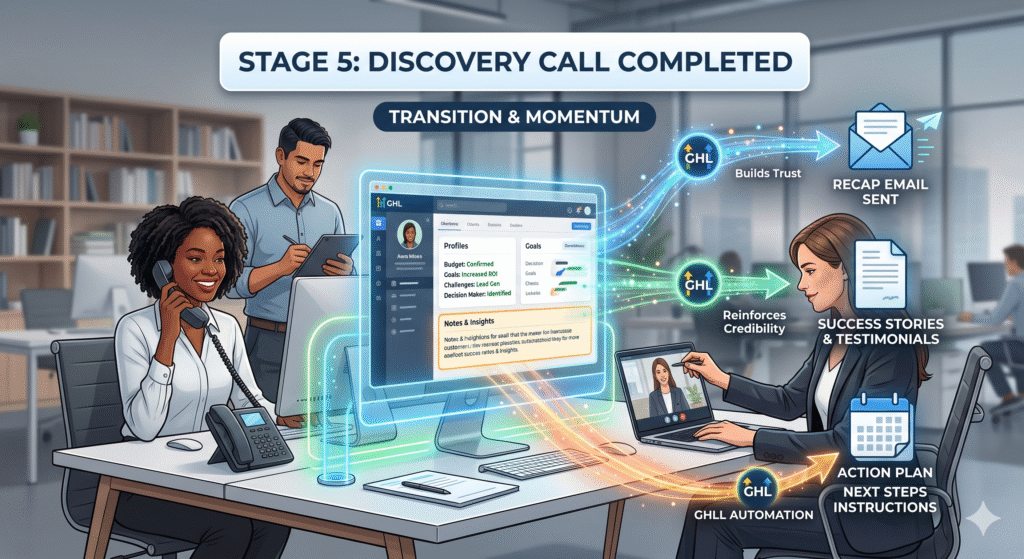
Stage 5: Discovery Call Completed
Completing the discovery call marks an important transition in the sales process.
At this stage, agencies have gathered detailed information about the prospect’s goals, challenges, budget, and decision-making process.
This information often determines whether the opportunity moves forward.
A strong GHL CRM setup allows agencies to record notes, track key insights, and trigger post-call workflows automatically.
Many agencies use Gohighlevel automation to send recap emails, case studies, testimonials, and next-step instructions immediately after the meeting.
These follow-up actions help maintain momentum while reinforcing trust and credibility.
Stage 6: Proposal Sent
The Proposal Sent stage represents one of the most critical points in the pipeline.
At this stage, prospects have expressed enough interest to evaluate a formal solution.
Unfortunately, many opportunities stall here because agencies fail to maintain communication after delivering proposals.
Successful agencies build automated follow-up sequences that keep prospects engaged throughout the decision-making process.
Professional Gohighlevel expert services often include proposal nurturing workflows that send reminders, answer common objections, and encourage continued conversation.
This stage benefits greatly from structured follow-up rather than passive waiting.
Stage 7: Negotiation and Decision Phase
Few deals close immediately after a proposal is delivered.
Most opportunities enter a negotiation phase where pricing, scope, timelines, and expectations are discussed.
A dedicated negotiation stage provides visibility into active opportunities that are progressing toward a final decision.
Many agencies use GHL Virtual Assistant support during this phase to coordinate communication, schedule follow-up meetings, and maintain accurate CRM records.
This stage is especially important for forecasting because it helps agencies understand which opportunities are likely to close in the near future.
Stage 8: Closed Won
The Closed Won stage marks the successful completion of the sales process.
However, many agencies make the mistake of treating this as the end of the customer journey.
In reality, onboarding begins immediately after the sale.
A strong GHL CRM setup automatically transitions new clients into onboarding workflows designed to streamline implementation and improve customer experiences.
Many agencies use Gohighlevel automation to deliver welcome emails, onboarding forms, kickoff meeting invitations, and training materials automatically.
This creates a smooth transition from sales to fulfillment while reducing manual workload.
Stage 9: Closed Lost
Not every opportunity will convert.
The Closed Lost stage helps agencies understand why deals are not moving forward.
Tracking lost opportunities provides valuable insights into pricing concerns, competitive pressures, service gaps, and sales process weaknesses.
Professional Gohighlevel expert services often include reporting systems that analyze loss reasons and identify trends that impact sales performance.
Understanding why prospects decline helps agencies improve future conversion rates.
A lost opportunity should always become a learning opportunity.
Why Pipeline Automation Changes Everything
A pipeline becomes significantly more powerful when combined with automation.
Many agencies manually update stages and manage follow-up tasks, creating unnecessary administrative work.
With properly configured Gohighlevel automation, every pipeline movement can trigger actions automatically.
These actions may include:
Lead assignment
Email sequences
SMS campaigns
Task creation
Appointment reminders
Internal notifications
Customer onboarding workflows
Automation ensures consistency while reducing human error.
Agencies that automate pipeline management often experience higher productivity and faster response times.
The Role of a GHL Virtual Assistant in Pipeline Management
As agencies grow, pipeline management becomes increasingly complex.
A skilled GHL Virtual Assistant helps maintain CRM accuracy by updating records, monitoring opportunities, reviewing automation performance, and ensuring leads move through the pipeline correctly.
This support allows sales teams to focus on conversations and conversions rather than administrative tasks.
Many agencies view virtual assistants as an extension of their CRM operations because they help maintain organization and improve overall efficiency.
How Funnel Builder Supports Pipeline Performance
The quality of leads entering the pipeline directly affects conversion rates.
This is where the GoHighLevel Funnel Builder plays a critical role.
A well-designed funnel attracts qualified prospects, collects relevant information, and prepares leads for the sales process before they enter the CRM.
When the Funnel Builder and pipeline work together, agencies gain better lead quality, improved segmentation, and stronger sales outcomes.
The result is a more predictable and scalable client acquisition system.
Why Custom Pipeline Stages Outperform Generic CRM Templates
One of the biggest mistakes agencies make when implementing GoHighLevel is relying on generic CRM templates that do not reflect their actual sales process. While pre-built templates can help agencies get started quickly, they rarely provide the visibility needed to manage leads effectively as the business grows.
Every agency has a unique customer journey. Some prospects move quickly from inquiry to onboarding, while others require multiple discovery calls, proposal revisions, and nurturing sequences before making a decision. A pipeline that fails to reflect these realities often creates confusion and inaccurate forecasting.
This is why a strategic GHL CRM setup focuses on customizing stages based on how prospects actually move through the buying process. Agencies that tailor their pipelines gain better visibility into lead quality, sales velocity, bottlenecks, and conversion opportunities.
Many businesses that invest in professional Gohighlevel expert services discover that small adjustments to pipeline structure can dramatically improve sales team productivity. When CRM stages accurately mirror customer behavior, teams spend less time managing data and more time closing deals.
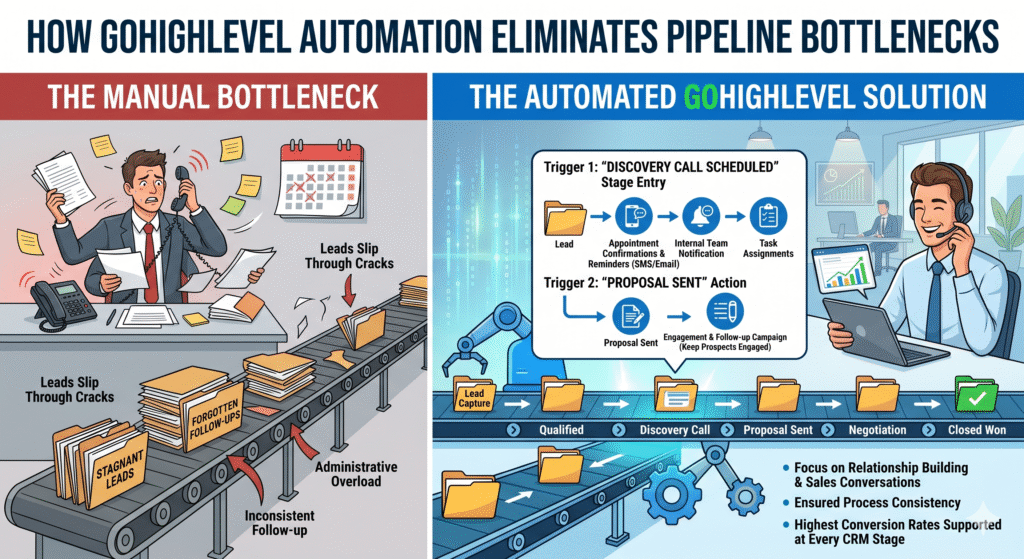
How Gohighlevel Automation Eliminates Pipeline Bottlenecks
As agencies scale, manual pipeline management quickly becomes unsustainable. Sales representatives often forget to follow up, opportunities become stagnant, and valuable leads slip through the cracks.
This is where advanced Gohighlevel automation becomes a game-changer.
Instead of relying on manual reminders, agencies can automate critical actions whenever a lead enters or exits a specific pipeline stage. For example, moving a lead into the Discovery Call Scheduled stage can automatically trigger appointment confirmations, reminder sequences, internal notifications, and task assignments.
Similarly, when a proposal is sent, automation can launch follow-up campaigns designed to keep prospects engaged throughout the decision-making process.
By removing repetitive administrative tasks, automation ensures consistency while allowing teams to focus on relationship building and sales conversations.
The agencies achieving the highest conversion rates are often the ones using automation to support every stage of their CRM process.
Why a GHL Virtual Assistant Becomes Essential as Agencies Scale
Managing hundreds or even thousands of leads requires ongoing CRM maintenance.
As pipelines grow, it becomes increasingly difficult for sales teams to update records, monitor automation performance, track opportunities, and maintain data accuracy.
This is where a skilled GHL Virtual Assistant provides tremendous value.
A virtual assistant can help maintain CRM hygiene by ensuring opportunities are updated correctly, duplicate records are removed, appointments are confirmed, and pipeline stages accurately reflect current prospect status.
Beyond administrative support, many virtual assistants also monitor automation workflows, identify stalled opportunities, and generate reports that help agencies improve overall sales performance.
For growing agencies, a GHL Virtual Assistant often becomes a critical part of CRM operations because they help keep systems organized while reducing the workload placed on sales teams.
The result is a cleaner pipeline, better reporting accuracy, and stronger conversion performance.
How the Funnel Builder Improves Pipeline Quality
A CRM pipeline is only as effective as the leads entering it.
Many agencies focus heavily on pipeline optimization while overlooking the quality of the lead generation process itself.
The GoHighLevel Funnel Builder plays a crucial role in ensuring that prospects entering the CRM are properly qualified and segmented.
Well-designed funnels collect important information before prospects ever reach the sales team. This may include business size, budget, goals, service interests, and readiness to buy.
This information allows agencies to place leads into the correct pipeline stages immediately while triggering relevant automation workflows.
When the Funnel Builder and CRM work together, agencies gain a more efficient sales process because leads arrive with greater context and qualification.
This alignment reduces wasted time and increases the likelihood of successful conversions.
Building a Scalable Agency Growth System
The most successful agencies do not treat their CRM as a simple contact database. Instead, they use it as the operational backbone of their entire sales and client acquisition process.
A properly structured GHL CRM setup, supported by intelligent Gohighlevel automation, managed by a skilled GHL Virtual Assistant, strengthened through an optimized Funnel Builder, and refined through professional Gohighlevel expert services, creates a scalable system capable of supporting long-term growth.
As lead volume increases, agencies need systems that maintain consistency without increasing complexity. The right CRM structure allows businesses to track every opportunity, automate repetitive processes, improve customer experiences, and generate accurate forecasting data.
Ultimately, the agencies that scale most efficiently are not necessarily those generating the most leads. They are the agencies with the best systems for managing, nurturing, and converting those leads into long-term clients.