
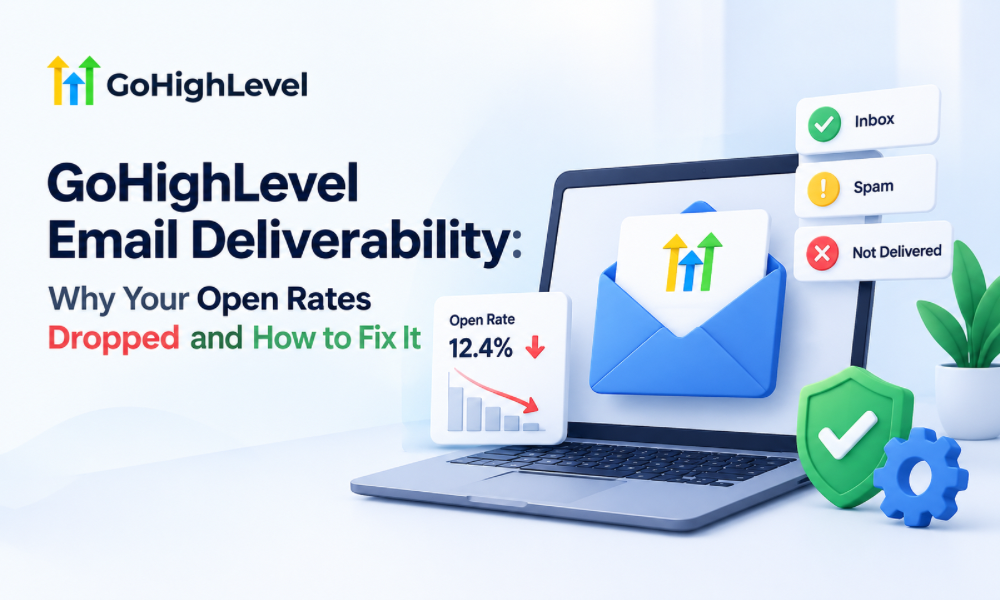
Email marketing can look perfectly healthy inside GoHighLevel until one day the numbers start moving in the wrong direction. Open rates fall, fewer contacts respond, and campaigns that previously performed well suddenly seem to disappear from inboxes. While it is tempting to blame the subject line or assume your audience has lost interest, declining email performance often starts with deliverability.
GoHighLevel gives businesses powerful tools for campaigns, workflows, follow-ups, and lead nurturing, but the platform can’t guarantee every message reaches the primary inbox. Your sending domain, authentication, email reputation, list quality, engagement, sending patterns, and message content all influence how receiving providers treat your emails.
Understanding these factors makes it much easier to diagnose a sudden drop instead of changing several things at once. Whether you manage email marketing for an agency, run automated follow-ups, or use GHL for real estate, the goal should be to build a sending system that consistently earns engagement and maintains a healthy reputation.
What Email Deliverability Actually Means in GoHighLevel
Email deliverability is your messages’ ability to reach recipients’ inboxes rather than being rejected, blocked, or filtered into spam. This is different from simply seeing a message marked as “sent” in GoHighLevel.
A campaign can technically be sent without generating the results you expect. Receiving providers such as Gmail, Outlook, and Yahoo make their own decisions about where a message belongs. They evaluate signals associated with the sender, domain, recipient engagement, message characteristics, and previous sending behavior.
This means a lower open rate does not automatically indicate that your email copy has become worse. Your emails may be reaching fewer inboxes in the first place, or they may increasingly be landing in spam or promotional folders.
Why Your GoHighLevel Open Rates May Suddenly Drop
There is rarely one universal reason for a decline in open rates. Sometimes several smaller problems develop at the same time.
One common cause is a change in sender reputation. If your domain has recently sent a large number of emails, generated more complaints, or experienced poor engagement, mailbox providers may become more cautious about your messages.
Another possibility is list deterioration. Contacts who have not interacted with your emails for months can bring down overall engagement. Old leads, purchased databases, duplicated contacts, abandoned addresses, and inactive subscribers can all make your campaigns less healthy.
A sudden increase in sending volume can also create problems. For example, if your account normally sends several hundred emails per day and suddenly starts sending several thousand, that unusual behavior may deserve closer attention.
Check Your Email Authentication Before Changing Your Campaign
Before rewriting every subject line, check whether your sending domain is properly authenticated.
Email authentication helps receiving providers determine whether messages are genuinely being sent on behalf of your domain. The major technologies involved include SPF, DKIM, and DMARC.
SPF identifies authorized sending infrastructure. DKIM adds a cryptographic signature to messages, helping verify that the email has not been altered and is associated with an authorized domain. DMARC builds on authentication by allowing domain owners to specify how receiving servers should handle messages that fail authentication checks.
If authentication is missing, incorrectly configured, or misaligned, deliverability can suffer. This is especially important when using custom sending domains and multiple email services.
A technically strong campaign cannot compensate for a poorly configured sending domain.
Your Sending Domain Has a Reputation Too
Many businesses focus heavily on the reputation of their GoHighLevel account while overlooking the reputation of the domain used for sending.
Mailbox providers can develop a historical view of your domain’s behavior. If recipients frequently engage with your emails, rarely report spam, and your sending activity remains consistent, those signals can work in your favor.
On the other hand, repeatedly sending unwanted messages, generating complaints, or maintaining large numbers of inactive contacts can contribute to weaker performance.
This is why switching domains simply because open rates declined is not always the right solution. A new domain does not magically solve poor targeting or weak list hygiene. The underlying sending practices still need to be corrected.
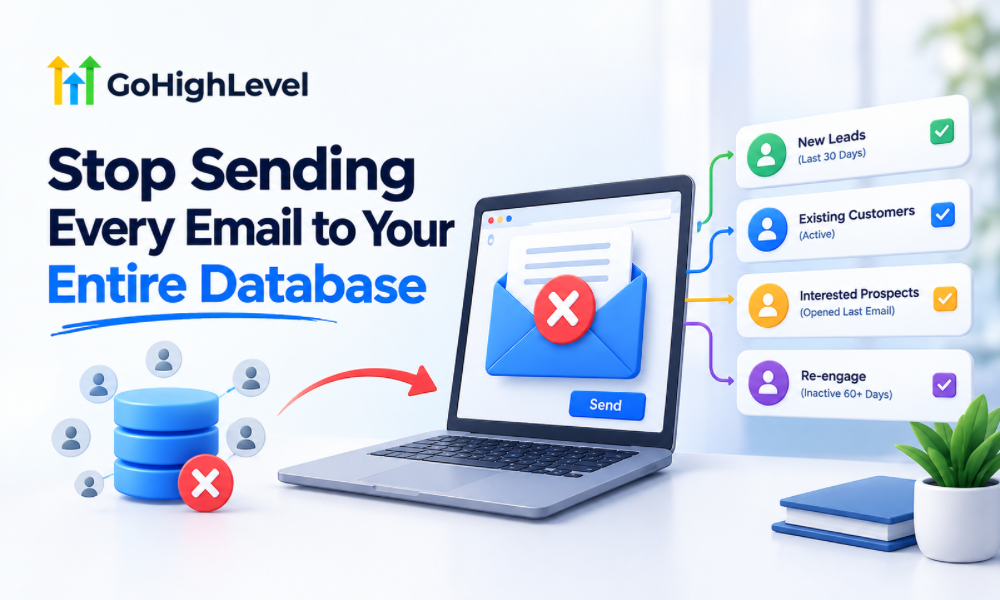
Stop Sending Every Email to Your Entire Database
One of the easiest ways to damage engagement is treating your entire CRM as one audience.
Someone who downloaded an ebook yesterday should not necessarily receive the same email sequence as someone who has ignored your company for two years. Their interests, buying intent, and expectations are completely different.
Segmentation allows you to adjust communication based on meaningful differences between contacts. You might separate prospects by service interest, lead source, lifecycle stage, previous engagement, location, or customer status.
This is particularly valuable when building GHL for real estate campaigns. A buyer looking for a home should not receive the same sequence as a seller, investor, past client, or completely inactive lead.
Better segmentation can improve engagement without requiring you to send more emails.
Clean Your Contact Database Regularly
A large contact list can create a false sense of success.
Having 50,000 contacts does not necessarily mean your email marketing is healthier than a business with 5,000 highly engaged subscribers. If a significant portion of your database never opens, clicks, replies, or otherwise interacts with your messages, those contacts may be contributing little value.
Regular list hygiene helps identify invalid addresses, repeated bounces, inactive subscribers, and contacts who no longer want communication.
Instead of continuously increasing your sending volume, look at who is actually engaging. A smaller audience with stronger engagement can be more valuable than a huge database that consistently ignores your messages.
Be Careful With Automated Follow-Up Sequences
Automation is one of GoHighLevel’s biggest advantages, but automation can also multiply a problem.
Suppose a workflow contains several follow-up emails and a poorly targeted trigger adds thousands of contacts to it. A mistake that would have affected a handful of contacts manually can suddenly produce a large volume of irrelevant messages.
Before activating an important workflow, examine its trigger, filters, timing, stop conditions, and communication frequency. Make sure contacts are removed when they respond, book an appointment, make a purchase, unsubscribe, or otherwise reach the intended goal.
A GHL automation specialist can be particularly useful when multiple workflows interact with the same contact database. Deliverability problems sometimes come from overlapping automations rather than from a single campaign.
Your Open Rate May Not Tell the Whole Story
Open rates are useful, but they should not be treated as a perfect measurement of email performance.
Email privacy features and changes in how mailbox providers handle tracking can make open data less straightforward than it once was. Depending on the recipient’s email environment, a recorded open may not always represent a person deliberately opening the email, while an unrecorded open does not necessarily mean the recipient ignored it.
Look at other signals alongside opens. Clicks, replies, booked appointments, conversions, unsubscribe rates, bounce rates, and spam complaints can provide a more complete picture.
For example, if opens decreased slightly but qualified replies and appointments stayed stable, the situation may not be as serious as the open-rate number suggests.
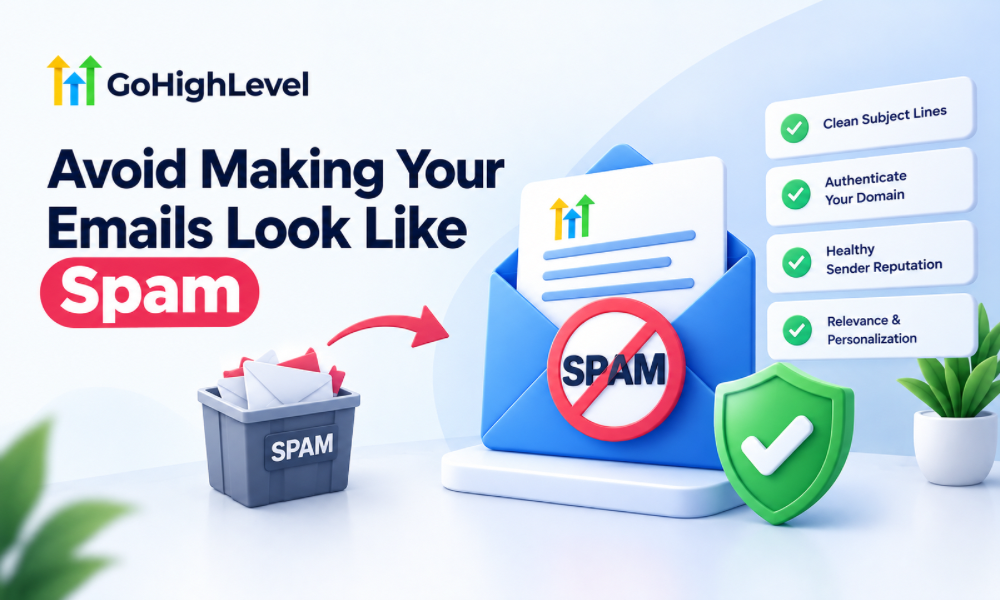
Avoid Making Your Emails Look Like Spam
Deliverability is not purely a technical problem. Your actual email content matters too.
Emails overloaded with exaggerated claims, excessive punctuation, misleading language, unnecessary capitalization, or aggressive promotional messaging can create a poor recipient experience. Even when a particular word does not automatically send an email to spam, the overall message and recipient behavior still matter.
Write emails that sound like something a real business would genuinely send to a real customer.
Keep the purpose of each message clear. If you want a prospect to schedule a consultation, explain why the conversation is useful instead of surrounding the call to action with excessive promotional language.
Give Recipients a Reason to Engage
Inbox providers pay attention to how recipients interact with messages. If people consistently ignore, delete, report, or unsubscribe from your emails, that behavior can become an important negative signal.
The solution is not simply to manipulate engagement. Instead, make your emails genuinely useful.
A good nurture sequence might answer common questions, provide relevant information, address objections, share useful resources, and introduce an offer when the recipient is ready.
This is especially important for long sales cycles. Sending a sales pitch in every email can quickly cause subscribers to disengage.
Review Your Email Frequency
More communication does not automatically mean more conversions.
A contact who receives three unrelated emails in one day because they entered multiple workflows may become frustrated even if every individual email looks reasonable.
Review how often contacts can receive messages across campaigns and workflows. Establish sensible communication rules so that different automations do not overwhelm the same person.
This is one area where a GoHighLevel freelancer can help businesses audit existing workflows and identify unnecessary overlaps without rebuilding the entire CRM from scratch.
Don’t Suddenly Increase Your Sending Volume
If your sending volume needs to grow substantially, do it carefully.
A sudden jump from a small audience to a massive campaign can look unusual, particularly for a relatively new sending domain. Businesses should establish consistent sending patterns and gradually scale when appropriate rather than treating email volume like a switch that can be turned from low to maximum overnight.
The right approach depends on your domain history, audience, campaign type, and infrastructure. There is no universal daily number that guarantees good deliverability.
Consistency and recipient engagement matter more than chasing an arbitrary volume target.
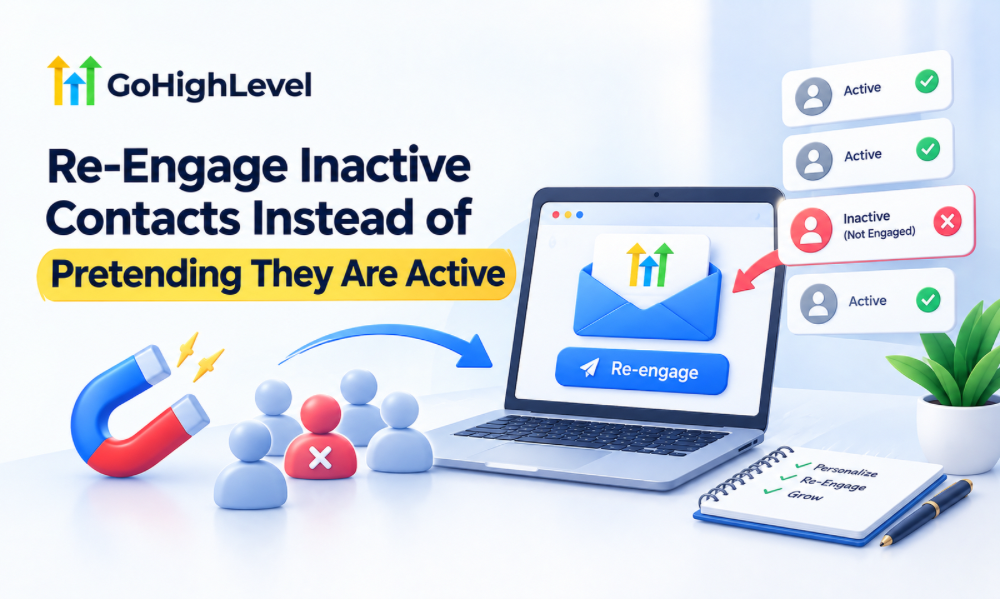
Re-Engage Inactive Contacts Instead of Pretending They Are Active
Not every inactive contact needs to remain in your regular campaigns indefinitely.
A re-engagement sequence can give subscribers an opportunity to confirm that they still want to hear from you. The messaging can be simple: remind them what they originally signed up for, offer something useful, and give them a clear choice to continue receiving communication.
Contacts who remain completely unresponsive can then be treated differently from active subscribers.
This helps your main campaigns focus on people who are more likely to engage instead of repeatedly mailing an audience that has demonstrated little interest.
Check Your Bounce and Complaint Patterns
Open rates should never be analyzed alone.
A rise in hard bounces can indicate poor data quality or outdated contact information. A rise in spam complaints can indicate problems with targeting, expectations, content, frequency, or consent.
If these metrics begin moving in the wrong direction at the same time as open rates decline, investigate the underlying cause before launching more campaigns.
Your CRM should help you identify patterns rather than simply report the final open-rate percentage.
When You Should Bring in a GoHighLevel Specialist
Some deliverability issues are simple enough to diagnose internally. Others become complicated when several domains, campaigns, workflows, pipelines, and integrations are involved.
If your team is unsure whether the problem comes from authentication, contact management, workflow logic, campaign configuration, or sending behavior, it may make sense to hire GoHighLevel consultant support.
An experienced consultant can review the account structure, identify workflow conflicts, evaluate segmentation, examine campaign practices, and help establish a more sustainable email process.
For businesses heavily dependent on automated lead nurturing, the value is not simply fixing one campaign. It is creating an infrastructure that reduces the likelihood of the same problem appearing again.
When It Makes Sense to Hire a GoHighLevel Expert
A more complex CRM often needs more than basic campaign setup.
If your business uses multiple pipelines, appointment systems, lead sources, sales teams, forms, automations, and long-term nurture sequences, diagnosing deliverability manually can become time-consuming.
In that situation, you may want to hire a GoHighLevel expert who can examine how your entire system communicates with contacts. The goal should be to understand why engagement changed and build a cleaner system around your actual customer journey.
The best solution is rarely “send more emails.” It is usually a combination of technical configuration, better targeting, cleaner data, appropriate frequency, and stronger content.

A Practical Recovery Strategy for Dropping Open Rates
Start by checking your sending domain and authentication setup. Then review bounce, complaint, unsubscribe, click, reply, and engagement trends to determine whether the issue is technical, audience-related, or both.
Next, examine your workflows. Look for duplicate messages, incorrect triggers, contacts entering inappropriate sequences, and missing stop conditions.
After that, segment your database and separate highly engaged contacts from inactive ones. Adjust your campaigns so that each audience receives communication relevant to its current stage.
Finally, monitor performance over time rather than judging the recovery from one campaign. Deliverability is influenced by accumulated sending behavior, so meaningful improvements may require consistent changes rather than a single quick fix.
Better Deliverability Starts With Better Email Operations
A drop in GoHighLevel open rates should be treated as a diagnostic signal rather than a reason to panic.
The problem could involve authentication, domain reputation, inactive contacts, excessive frequency, poor segmentation, workflow errors, or changing engagement patterns. In many cases, several of these factors exist together.
The strongest approach is to look at the complete system. Make sure your technical foundation is sound, your audience actually wants your communication, your automated workflows behave logically, and your content provides a reason for recipients to continue engaging.
GoHighLevel can make sophisticated email automation possible, but sustainable deliverability comes from how that automation is designed and managed. When businesses combine clean data, responsible sending practices, relevant messaging, and thoughtful workflow architecture, they create a much stronger foundation for long-term email performance.