
GHL Pipeline Management Deep Dive
Why Most Businesses Misuse GHL Pipelines
Many businesses adopt GoHighLevel, expecting it to instantly organize their sales process.They create a pipeline.They add stages.They move opportunities around.And then nothing changes.Deals still stall.Follow-ups still get missed.Revenue remains inconsistent.At GoHighLevelExpert Services, we see this pattern constantly. The issue is not the platform. It stems from a misunderstanding of how pipeline management is supposed to function within GHL.A pipeline is not just a visual board.It is a revenue control system.This deep dive explains how to properly structure, automate, optimize, and scale GHL pipeline management to make it a predictable growth engine.
What a GHL Pipeline Is Actually Designed To Do
Inside GoHighLevel, a pipeline is meant to:
- Track opportunity progression
- Trigger automation based on stage movement
- Provide real-time revenue forecasting
- Expose bottlenecks
- Align marketing and salesMost SMEs treat it as a checklist. That is where underperformance begins.When structured properly, a GHL pipeline becomes:
- A visibility tool
- A discipline system
- A follow-up safeguard
- A forecasting dashboardThis is why serious businesses often choose to hire gohighlevel experts rather than attempt DIY setups that lack strategic structure.
The Core Philosophy Behind High-Performance Pipelines
Before building stages, understand this principle:
Every stage must represent a behavioral milestone, not an internal feeling.
Weak stage example:
- Interested
- Maybe
- Follow up laterStrong stage example:
- Initial Contact Made
- Qualification Completed
- Discovery Call Booked
- Proposal Sent
- Negotiation
- Closed Won
- Closed LostStages should reflect real progress, not assumptions.At GoHighLevelExpert Services, we redesign pipelines around behavioral clarity because that clarity drives automation accuracy.
Step 1: Build a Pipeline That Mirrors Reality
Many businesses design “ideal” pipelines instead of real ones.
Your pipeline should reflect:
- How leads actually enter
- How qualification happens
- How long decisions take
- Where deals typically stallIf your sales process takes 21 days on average, your pipeline must reflect that pace.If most deals stall after proposals, that stage requires automation reinforcement.Pipeline design must be grounded in real operational data.This is often why companies decide to hire gohighlevel experts — because guessing pipeline structure is expensive in the long term.
Step 2: Limit Stage Overload
Too many stages create confusion. Too few create ambiguity.
Optimal pipelines typically contain:
- 5 to 8 stages
- Clear entry and exit criteria
- Defined next actionsWhen pipelines exceed 10 stages, tracking discipline drops.Clarity increases accountability. Complexity reduces usage.
Step 3: Define Stage Movement Rules
A stage should not change casually.
Each stage needs:
- A defined trigger
- A defined action
- A defined ownerFor example:Moving to “Proposal Sent” should trigger:
- Automated follow-up email
- Task creation for sales rep
- Reminder sequence if unopenedThis is where pipeline management connects directly to automation.Without this integration, pipelines are passive.
Step 4: Automate Based on Pipeline Stage Changes
This is where GHL becomes powerful.
Every stage movement should activate: Learn more about our GHL CRM setup service.
- Communication sequences
- Internal notifications
- Task reminders
- Delay triggers
- Conditional logicPipeline management without automation is manual tracking.Pipeline management with automation is operational leverage.At GoHighLevelExpert Services, automation alignment is one of the primary reasons businesses choose to hire GoHighLevelExperts rather than rely on templates.
Step 5: Use Pipelines for Forecasting, Not Just Tracking
A well-structured pipeline reveals:
- Deal velocity
- Conversion rate per stage
- Revenue projections
- Drop-off patternsThis allows leadership to answer questions like:
- Where are we losing deals
- How long does it take to close
- Which stage needs optimizationWithout structured pipeline reporting, revenue forecasting becomes guesswork.
Common GHL Pipeline Mistakes
- No Stage DefinitionsTeam members move deals arbitrarily.
- No Automation ConnectionStages change, but nothing triggers.
- No Cleanup DisciplineStale deals remain indefinitely.
- No Ownership ClarityMultiple users edit without accountability.These errors reduce pipeline credibility and eventually cause teams to stop trusting the system.
The Role of Design in Pipeline Adoption
Although pipelines are backend tools, presentation matters.
When dashboards are:
- Clean
- User-friendly
- Easy to navigate
- Intuitively structuredAdoption improves dramatically.The best implementations combine operational clarity with Excellent designs that make usage simple rather than overwhelming.Adoption determines effectiveness.
Pipeline Management for Multiple Services or Offers
If your business sells:
- Multiple services
- Different price tiers
- Separate audiencesYou may need separate pipelines.However, avoid unnecessary duplication.Separate pipelines only when:
- Sales processes differ significantly
- Qualification criteria changes
- Deal cycles vary drasticallyOtherwise, use tagging and automation to differentiate.Strategic pipeline architecture is a common reason companies hire goHighLevel experts.
Cleaning and Maintaining Pipeline Hygiene
Pipelines decay when:
- Old deals remain open
- Stages are skipped
- Tasks are ignored
- No periodic review occursBest practice:
- Weekly pipeline review meetings
- Automatic stale deal alerts
- Defined lost deal rules
- Clear archival processClean pipelines increase forecasting accuracy.
Scaling Pipelines as Teams Grow
As businesses grow:
- More sales reps join
- More leads flow in
- More automation runsWithout a disciplined structure, pipelines become chaotic.Scaling successfully requires:
- Role-based access control
- Defined stage permissions
- Automation safeguards
- Process documentationThis is where GoHighLevel expert services support long-term scalability rather than short-term setup.
Why Pipeline Structure Affects Customer Experience
Pipeline organization affects more than internal clarity.
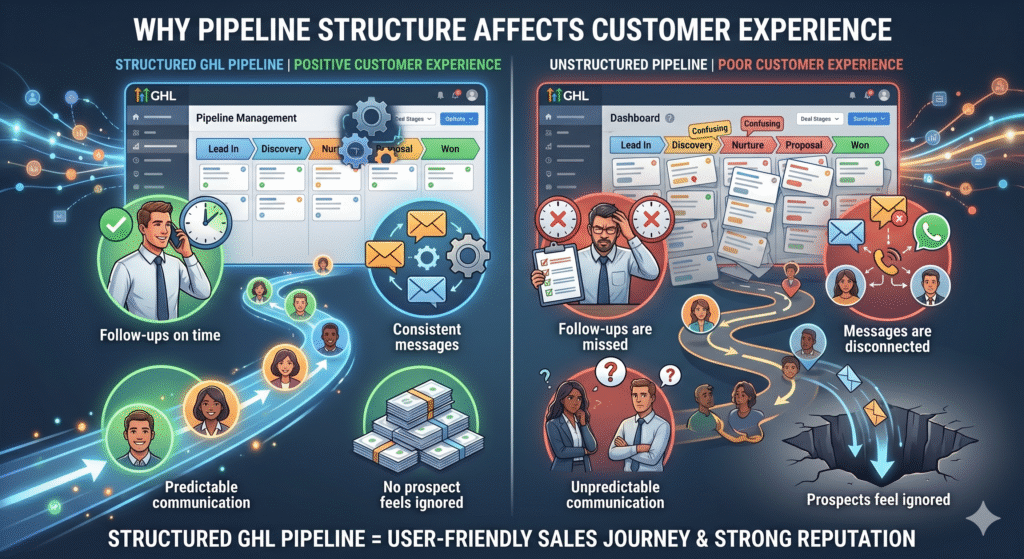
When structured properly:
- Follow-ups happen on time
- Messages are consistent
- Clients receive predictable communication
- No prospect feels ignoredThis creates a user-friendly sales journey from first contact to close.Pipeline health directly impacts reputation.
Leveraging GHL Updates for Pipeline Improvement
GoHighLevel regularly introduces Free updates that improve:
- Workflow logic
- Reporting features
- CRM enhancementsBusinesses that maintain clean architecture can integrate these improvements seamlessly.Messy systems struggle to adapt.This is why long-term pipeline health matters.
Mobile Accessibility and Operational Responsiveness
Modern teams frequently operate on mobile devices.
Pipeline views must remain:
- Fully responsive
- Easy to scroll
- Simple to update
- Clear under pressureMobile usability increases discipline and reduces missed follow-ups.
When to Hire Gohighlevelexperts for Pipeline Management
You should strongly consider hiring professionals if: See our GHL automation services.
- Revenue forecasting feels inconsistent
- Deals frequently stall
- Automation is disconnected from stages
- Sales reps ignore the CRM
- Scaling introduces confusionChoosing to hire gohighlevel experts prevents the need to rebuild pipelines repeatedly.Expert implementation avoids the expense of trial-and-error.
Pipelines Are Revenue Infrastructure
A GHL pipeline is not a feature.It is revenue infrastructure.
When structured correctly, it:
- Reduces manual follow-up
- Improves conversion rates
- Strengthens forecasting accuracy
- Supports team accountability
- Creates predictable growthAt GoHighLevelExpert Services, we help businesses move beyond visual boards into disciplined revenue systems.Because pipelines do not increase sales by existing.They increase sales when:
- Designed intentionally
- Automated intelligently
- Maintained consistently
- Aligned with real behaviorAnd when implemented properly, they transform GoHighLevel from a CRM into a scalable operating system.
Designing Automation That Thinks Ahead
Most automation reacts to stage changes.Elite pipeline systems anticipate what will happen next.
For example:
If a lead enters “Proposal Sent,” automation should:
- Trigger follow-up emails
- Create reminder tasks
- Send internal alerts if unopened
- Escalate after a defined delay
- Move to nurture if inactiveThis layered automation creates a safety net.Without it, opportunities quietly fade.
The Power of Conditional Logic in Pipeline Management
GoHighLevel allows conditional automation based on:
- Tag presence
- Pipeline stage
- Time in stage
- User friendly
- Custom fieldsThis means you can design logic such as:If the deal stays in “Negotiation” longer than 5 daysThen notify the sales managerIf the deal value exceeds a thresholdThen trigger executive involvementIf the prospect repliesThen pause the automated sequenceThis kind of dynamic control is what separates simple CRM usage from strategic pipeline engineering.It is also one of the main reasons businesses choose to scale by hiring goHighLevel experts rather than relying on static templates.
Using Time-in-Stage Metrics to Identify Bottlenecks
One of the most underutilized features in GHL pipeline management is stage duration analysis.
Ask:
- How long does a deal stay in each stage
- Which stage consistently slows down
- Where does the drop-off rate spikeIf deals linger in “Qualification,” your sales process may lack clarity.If deals stall in “Proposal Sent,” your offer positioning might need adjustment.Pipeline data is diagnostic.At GoHighLevelExpert Services, we use stage duration to uncover hidden revenue leaks.
Revenue Forecasting With Weighted Pipelines
Not every deal has the same probability of closing.Advanced pipeline management assigns a weighted value by stage.
For example:
- Qualification Completed – 40 percent probability
- Proposal Sent – 65 percent probability
- Negotiation – 80 percent probabilityWeighted forecasting creates more accurate revenue projections.This allows leadership to:
- Predict cash flow
- Adjust ad budgets
- Plan hiring
- Set realistic growth targetsForecasting becomes strategic instead of emotional.
Aligning Marketing Campaigns With Pipeline Stages
Many businesses disconnect marketing and pipeline tracking.
Leads enter from: Learn more about GoHighLevel for B2B.
- Paid ads
- Organic search
- Email campaigns
- ReferralsBut the pipeline rarely tracks which source produces the fastest closing deals.Advanced integration allows you to:
- Compare conversion rate by lead source
- Identify the highest revenue channels
- Optimize acquisition strategyWhen marketing and pipeline data align, growth becomes measurable and scalable.Businesses that hire GoHighLevel experts often discover that campaign-level visibility dramatically improves ROI.
Building Multiple Pipelines Without Creating Chaos
As businesses expand, they often add:
- Separate pipelines for each service
- Separate pipelines for partnerships
- Separate pipelines for enterprise dealsThe mistake is duplicating logic unnecessarily.Instead, build pipelines around:
- Distinct sales processes
- Clear differences in qualification
- Different deal velocitiesDo not create new pipelines simply because a new offer launches.The architecture discipline ensures the system remains manageable.
Internal Accountability Through Pipeline Discipline
Pipeline success depends on team behavior.
To ensure accountability:
- Define stage movement rules
- Require notes before advancing
- Create automatic reminders for inactivity
- Review pipeline weeklyWithout discipline, even the best-designed pipeline degrades.At GoHighLevelExpert Services, we emphasize behavioral adoption as much as technical setup.
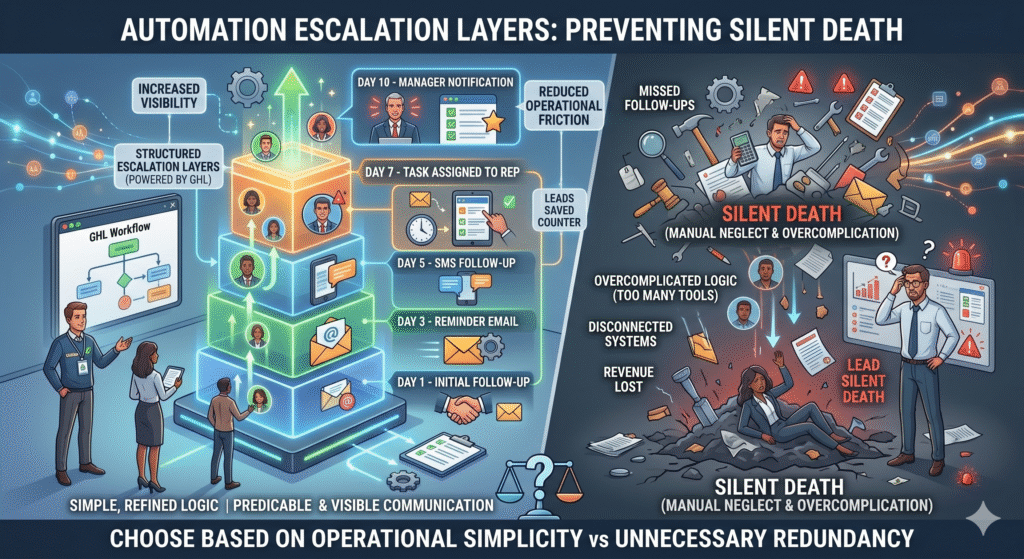
Automation Escalation Layers
One of the most powerful advanced strategies is escalation layering.
For example:Day 1 – Initial follow-upDay 3 – Reminder emailDay 5 – SMS follow-upDay 7 – Task assigned to repDay 10 – Manager notificationThis layered system prevents silent death.Escalation ensures visibility increases as urgency increases.Businesses that attempt to build this without guidance often overcomplicate the logic, which is why many ultimately hire gohighlevel experts to refine and simplify it.
Pipeline Hygiene at Scale
As deal volume grows, clutter becomes dangerous.
Establish rules for:
- Automatically marking lost deals
- Archiving inactive opportunities
- Clearing stale contacts
- Resetting miscategorized stagesClean pipelines improve reporting accuracy.They also improve team trust in the system.
Preventing Automation Conflicts
Over time, automation layers can conflict with each other.
Common issues include:
- Multiple workflows firing simultaneously
- Conflicting stage triggers
- Duplicate notifications
- Overlapping nurture sequencesRegular automation audits prevent these issues.This is an area where gohighlevel expert services frequently intervene to streamline systems that have grown organically without oversight.
Sales Velocity Tracking
Pipeline data can reveal:
- Average days to close
- Stage-by-stage velocity
- Rep performance differencesTracking sales velocity allows you to:
- Optimize qualification criteria
- Shorten proposal turnaround time
- Identify top-performing reps
- Adjust compensation structuresPipeline management is not just operational. It is strategic.
Integrating Client Experience With Pipeline Logic
A strong pipeline does more than manage internal data.It shapes external experience.
For example:When a deal moves to “Closed Won,” automation can: Book a free consultation →
- Trigger onboarding email
- Assign project manager
- Schedule kickoff call
- Send preparation checklistThis reduces confusion and enhances professionalism.Pipeline management influences client perception more than most businesses realize.
Role-Based Pipeline Permissions
As teams grow, not everyone should have full control.
Use role-based permissions to:
- Prevent accidental stage edits
- Restrict deletion access
- Protect automation logic
- Maintain reporting integrityWithout access control, pipelines become unstable.Businesses that scale quickly often realize too late that governance matters, which is another reason companies choose to hire gohighlevel experts.
Advanced Reporting Dashboards
Beyond pipeline view, build dashboards that show:
- Revenue by rep
- Conversion rate per stage
- Lost deal reasons
- Monthly forecasting trendsAdvanced dashboards convert pipeline data into actionable insights for executives.Data becomes decision-making fuel.
Lost Deal Analysis
Every lost deal contains intelligence.
Track:
- Primary reason lost
- Stage at loss
- Deal size
- Sales repPatterns reveal structural weaknesses.For example:If most losses occur after pricing discussions, positioning needs refinement.Pipeline data is not just about wins. It is about learning.
Long-Term System Evolution
Pipeline management should evolve as:
- Offers change
- Sales cycles shorten
- Teams grow
- Market conditions shiftSchedule quarterly pipeline reviews to assess:
- Stage relevance
- Automation effectiveness
- Reporting accuracyStatic pipelines become outdated quickly.
When Rebuilding Becomes Necessary
Sometimes pipelines become too complex to salvage.
Warning signs include:
- Excessive overlapping workflows
- Inconsistent stage definitions
- Team avoidance of CRM usage
- Forecasting inaccuraciesAt this stage, rebuilding with expert guidance costs less than patching.Businesses in this situation often choose to hire gohighlevel experts for a structured reset.
Why Pipeline Mastery Increases Enterprise Value
Investors and buyers evaluate operational clarity.
A disciplined GHL pipeline demonstrates:
- Revenue predictability
- Sales process maturity
- Data-driven culture
- Scalable infrastructurePipeline mastery increases business valuation.
Ready to implement this in your GHL account?
Book a free 45-minute strategy call. Our certified GoHighLevel specialists will audit your setup.
Get Your GHL Setup Done Right
Free 45-min audit call — zero cost, no commitment.
Our GHL Services
- GHL CRM Setup
- GHL Virtual Assistant
- Funnel Builder
- Automation Specialist
- White-Label SaaS
- GHL Migration
Popular Posts
- High-Converting GHL Sales Funnel
- GHL Automation Templates
- GHL Pipeline Management