
What Your Marketing Stack Really Costs: The Line Items Nobody Adds Up
Ask most agency owners what their software costs and you will get a number that is wrong by somewhere between thirty and sixty percent. Not because anybody is careless. Because the spend arrives in pieces, on different cards, at different times of the year, and nobody has ever sat down and added it all up in one place.
The subscriptions are only the visible part. Underneath them sit the connector you bought to move data between two tools, the seats you are paying for people who left in March, the two platforms quietly doing the same job, and the four hours a month somebody spends making two dashboards agree.
This is how to work out the real figure, and then how to decide honestly whether consolidating is worth it — including the cases where it is not.
How a stack doubles without anybody deciding
Nobody sets out to run eleven tools. It happens one sensible decision at a time, and every individual decision was defensible when it was made.
You start with one platform. A client needs something it does not do, so you add a second. The two need to talk, so a connector joins the bill. Somebody runs a campaign that needs a landing page builder and expenses it. A contractor brings their preferred scheduling tool and it sticks. Two years later there are eleven subscriptions, four of which nobody can name an owner for, and the monthly total has roughly doubled while the work has not.
The mechanism is worth naming because it tells you where the fix is: there is no moment where anybody evaluates the stack as a whole. Each tool was compared against the problem it solved, never against the tools already paid for. The audit below is really just the missing step.
The line items people forget
Seats, multiplied
A twelve-person team on a tool at £29 a seat is £348 a month. On five tools, that same team costs £1,740 before anybody has used anything. Per-seat pricing is the single largest hidden multiplier in a split stack, and it is the one that scales worst as you hire.
Then check how many of those seats are active. Most accounts are paying for between fifteen and thirty percent more seats than they have people, because deprovisioning is nobody’s job and licences roll over quietly at renewal.
The connector tax
Two tools that do not talk natively need something in between. That something costs money, costs setup time, breaks occasionally, and — the part people miss — becomes a dependency nobody owns. When it fails, leads stop arriving somewhere and you find out from a client.
Count the connector subscription, and then count the hours spent the last time it broke. That second number is usually larger.
Reconciliation hours
When your ad platform, your CRM and your reporting tool each hold a version of the truth, somebody spends time every month deciding which one to believe. Four hours a month at any sensible internal rate is real money, and it buys you nothing — it is pure friction created by the shape of the stack. Half of it disappears when the data stops living in three places; the other half is a measurement design problem covered in GoHighLevel conversion tracking.
Onboarding, paid twice
Every new hire learns every tool. Six tools means six logins, six sets of conventions, six places where something could be configured wrong. This cost is invisible because it is paid in days rather than invoices, but it is the one that compounds hardest as a team grows.
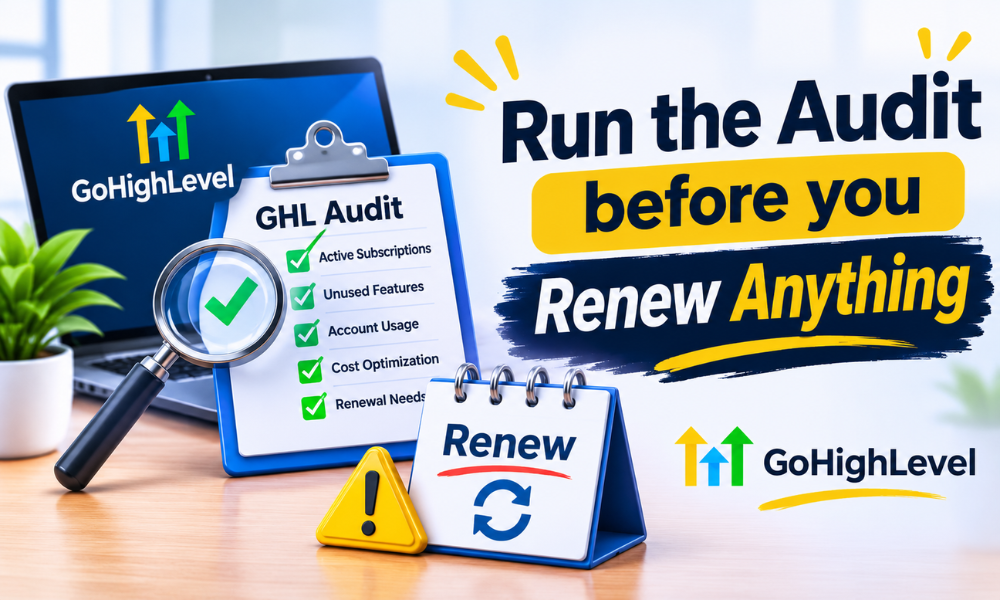
Run the audit before you renew anything
This takes an afternoon and it is the highest-return afternoon most agencies will spend this quarter. The only genuinely difficult part is the first step, because the data is scattered.
Export twelve months of charges from every card and account the business uses, including personal cards that get expensed. Put every recurring charge in one sheet with its amount, its renewal date, and a named human who owns it. Anything you cannot assign an owner to goes in a separate list — that list is usually where the easiest savings are.
Then go line by line and answer two questions for each: what breaks tomorrow if this disappears, and is anything else here doing the same job. Most people find at least one tool where the honest answer to the first question is “nothing”.
Do this before renewal season rather than during it. A tool that auto-renewed last week is a decision you have already made for another twelve months, whether you meant to or not.
What consolidation actually saves, and what it costs
The honest version: consolidating into one platform usually removes thirty to forty-five percent of software spend, and the saving comes mostly from seats and overlap rather than from any one tool being cheaper. The headline subscription often goes up. The total goes down.
The costs are real and people under-price them. There is a migration window of two to six weeks where attention goes to moving rather than selling. There is a period where the team is slower because they are learning. And there is almost always one thing the old tool did better that you will miss, which is worth identifying honestly before you commit rather than discovering it in week three. A planned GoHighLevel migration keeps that window at the short end; an improvised one is where the horror stories come from.
The clearest signal that consolidation is right: you are paying for a connector whose only job is to move data between two tools that a single platform would hold natively. That connector is a tax you pay monthly for a structural decision, and it does not get cheaper.
The clearest signal it is wrong: one of your tools is genuinely excellent at something specialised and central to how you make money. A best-in-class tool doing one thing superbly is worth keeping outside the stack. Consolidation is a default, not a religion.
A worked example with the numbers
An eight-person agency we worked with was running nine subscriptions. Their stated software cost was “about £900 a month”, which is what the two biggest invoices added up to. The actual twelve-month total, once every card was exported, was a little over £2,100 a month.
The gap was made of ordinary things. Twenty-two paid seats against fourteen people. A landing page builder nobody had opened in seven months, still billing. Two scheduling tools, one used by three staff and one by two, because two different clients had each introduced one. A connector at £79 a month moving form submissions between the CRM and the email tool. An annual plan that renewed in February for a product the team had stopped using in the previous October.
Consolidating the core — CRM, funnels, email, SMS, calendars and pipelines — into one platform took five weeks. They kept two specialist tools, because both were genuinely better than the built-in equivalents and both were central to delivery. Everything else went.
The new monthly figure was around £1,150, so the saving ran at roughly forty-five percent. But the part the owner actually cared about was different: one place to look when a client asked what happened to a lead, and one report that did not need reconciling against two others. The money was the smaller benefit. Rebuilding the capture and nurture flows during the move was ordinary GoHighLevel funnel builder work, and it is worth doing properly at that moment because you are touching everything anyway.
What one platform absorbs, and what it does not
Consolidation conversations go wrong when nobody is specific about scope. “Replace everything” is not a plan and it is not true. Here is the realistic division for most service businesses and agencies.
Absorbed comfortably, with no meaningful loss:
- CRM and contact database — the obvious one, and the one that should move first because everything else keys off it. A clean GoHighLevel CRM setup is the foundation the rest of the consolidation stands on.
- Email and SMS sending — including sequences, broadcasts and the automation that triggers them.
- Landing pages, funnels and forms — for most agencies these are genuinely interchangeable, and keeping a separate builder is usually habit rather than requirement.
- Calendars and booking — the single most common duplicate subscription, and almost always safe to collapse.
- Pipelines and deal tracking — provided your sales process is not unusually complex.
- Review requests and reputation chasing — a small tool most agencies pay for separately without needing to.
Worth thinking harder about before you move it:
- Accounting and invoicing — payments can run through the platform, but your accountant has opinions and they are usually correct. Leave the books where they are.
- Serious analytics — if you are doing cohort analysis or anything genuinely statistical, a built-in reporting module will frustrate you. Know that going in.
- Specialist vertical tools — dispatch software, clinical systems, legal case management. These exist because the general-purpose version is not good enough.
- Large video libraries and complex course delivery — workable, but a dedicated platform is better once you are past a few dozen lessons.
- Anything you resell under your own brand — that is a different decision entirely, and it changes the maths in your favour, because a white-label GoHighLevel SaaS setup turns a cost line into a revenue line.
The useful rule: a tool that stores data other tools need is a consolidation candidate. A tool that performs one specialised job and hands back a result is usually fine where it is.

Mistakes that make consolidation go badly
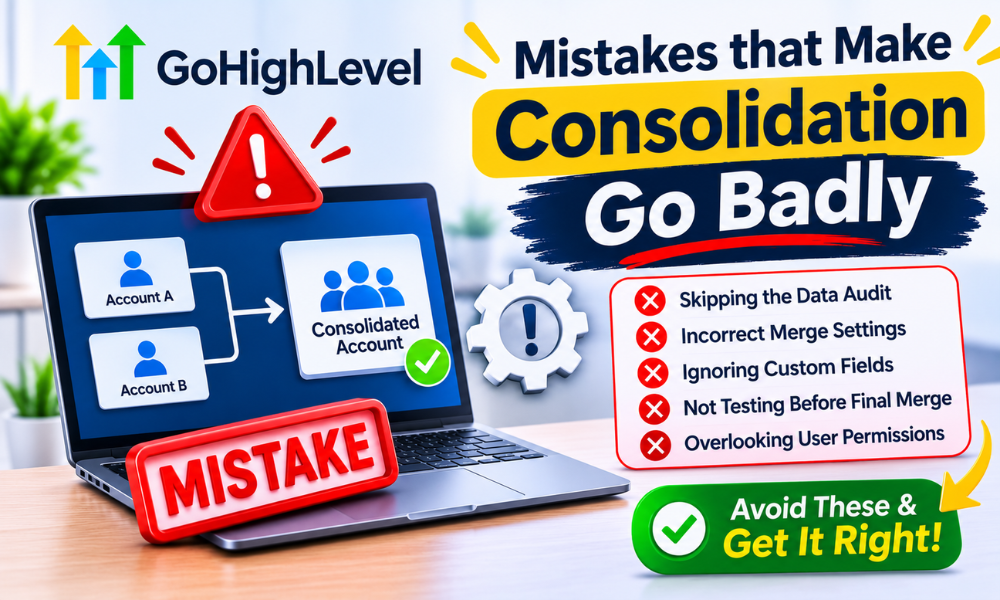
Migrating everything at once. Move the CRM and contact data first, run both systems briefly in parallel on new leads only, then move the rest. A big-bang cutover on a Friday is how agencies lose a fortnight of enquiries.
Not deciding who owns the new system. A consolidated stack with no owner becomes a fragmented stack again within a year, because the same pressure that created the original sprawl has not gone anywhere. Name somebody. For most teams this is a trained GoHighLevel virtual assistant doing a monthly pass over subscriptions and permissions.
Underestimating the data. Contact records migrate easily. Custom fields, tags, pipeline history and anything with a date on it do not, and this is where projects overrun. Audit the data shape before committing to a timeline, not after.
Cancelling too early. Keep the old subscription running for one full billing cycle past cutover. The month you discover something did not migrate is the month you will be grateful it is still there.
Frequently asked questions
How often should I audit the stack?
Once a year properly, and a five-minute check whenever anybody proposes a new tool: what are we already paying for that does part of this job? That second habit prevents more sprawl than the annual audit cures.
Is one platform always cheaper than several?
No. For a solo operator with two tools, consolidation saves almost nothing and costs a week. The savings scale with team size and with the number of overlapping subscriptions, which is why the maths changes sharply somewhere around five or six people.
What about tools the clients use rather than us?
Count them separately but do count them. Client-facing tools you pay for are part of your cost of delivery, and they are frequently where the oldest unreviewed subscriptions hide. If a tool exists because one client asked for it in 2023 and that client has since left, you have found something.
Should I move if I am mid-contract on something?
Usually yes, if the annual saving exceeds the remaining contract value. Run the number rather than assuming. Paying out four months on one tool to save on five others is often correct and rarely feels correct, which is why people default to waiting.
Does consolidating hurt if we later want to specialise?
Not much, provided you keep your data portable and avoid building critical logic you cannot export. The risk is less about the platform and more about undocumented automations only one person understands — which is a GoHighLevel developer discipline question rather than a vendor question.
Where to start this week
Export the last twelve months of charges from every card. Put them in one sheet. Add an owner column and fill it in. You will almost certainly find something billing that nobody has opened since last year, and the total at the bottom will not be the number you would have guessed.
That sheet is the whole decision. Everything after it — whether to consolidate, what to keep, how long it takes — follows from knowing what you actually spend. Most people never build it, which is precisely why the number keeps drifting upward.
If you would like a second pair of eyes on that sheet before you act on it, book a free GHL consultation. We will tell you what we would cut, what we would keep, and where we think consolidating would cost you more than it saves. Sometimes the answer is to leave it alone.