
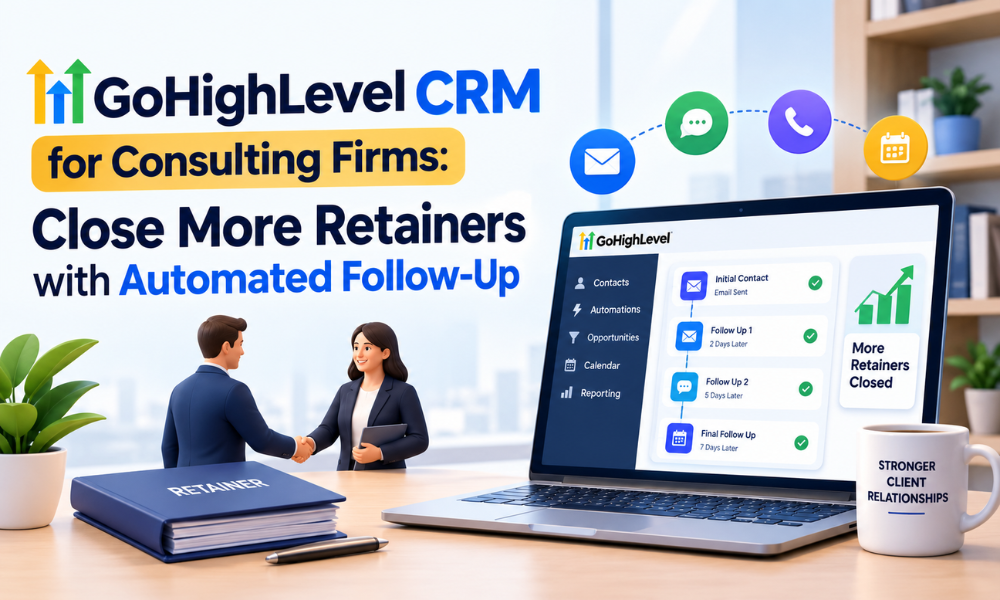
GoHighLevel CRM for Consulting Firms: Close More Retainers with Automated Follow-Up
GoHighLevel CRM helps consulting firms organize leads, manage sales pipelines, automate follow-ups, and turn more qualified prospects into long-term clients. By combining contact management, appointment scheduling, email and SMS communication, and workflow automation in one platform, consultants can reduce manual administration and maintain consistent communication throughout the sales journey.
For consulting businesses, winning a retainer often requires more than one sales call. Prospects may need time to evaluate proposals, discuss budgets, compare providers, or obtain approval from decision-makers. With effective GHL CRM setup and GoHighLevel automation, consulting firms can follow up at the right time, identify promising opportunities, and build stronger relationships without manually tracking every conversation.
Whether you run a management consultancy, marketing consultancy, financial advisory business, or specialist consulting agency, GoHighLevel can help you build a more organized client acquisition process. With the right GoHighLevel expert services, businesses can build a repeatable system that supports lead nurturing, proposal follow-ups, and recurring retainer sales.
What Is GoHighLevel CRM for Consulting Firms?
GoHighLevel CRM is a customer relationship management platform that helps businesses manage contacts, sales opportunities, appointments, communication, and automated workflows. For consulting firms, it serves as a central workspace to track prospects from their first enquiry through discovery calls, proposal discussions, contract signing, and ongoing client communication.
Instead of relying on disconnected spreadsheets, email inboxes, calendars, and reminders, consultants can organize important sales information in a shared system. Each contact can have a record containing communication history, lead details, appointment activity, and pipeline status. This makes it easier to understand what has happened and what needs to happen next.
The real advantage is the ability to connect these records with automated actions. When a prospect books a consultation, the CRM can trigger confirmations and reminders. When a proposal is sent, a workflow can schedule appropriate follow-ups. When a prospect becomes a client, the business can initiate onboarding activities.
However, automation works best when the underlying sales process is clearly defined. A CRM cannot compensate for an unclear offer, weak positioning, or an ineffective sales conversation. Consulting firms should first understand how prospects become clients, then configure GoHighLevel to support each stage.
How GoHighLevel CRM Works for Consulting Businesses
A consulting sales process typically includes several stages: initial enquiry, qualification, discovery meeting, proposal development, negotiation, and conversion. GoHighLevel allows businesses to represent these stages through a pipeline so that opportunities can be tracked consistently.
Centralized contact and lead management
Every new enquiry can be recorded with relevant information, such as the prospect’s business type, company size, service requirements, budget range, and expected timeline. Custom fields and tags can help organize contacts according to their needs and potential fit.
For example, a business consultancy might distinguish between prospects looking for a one-time strategy workshop and those seeking a six-month advisory retainer. These prospects may require different sales conversations, pricing structures, and follow-up schedules.
A structured GHL CRM setup makes this information easier to access and use. Consultants can review a prospect’s history before a meeting rather than searching through old messages or asking the same questions repeatedly.
Sales pipeline visibility
A pipeline gives the team a clear view of where each opportunity stands. Stages might include New Lead, Qualified Prospect, Discovery Call Booked, Proposal Sent, Decision Pending, Won, and Lost.
Each stage should have a clear definition. For instance, a lead should only move into Proposal Sent after a proposal has actually been delivered. Consistent stage definitions make reporting more reliable and help managers identify bottlenecks.
If numerous prospects remain in the proposal stage for weeks, the firm may need to improve its proposal presentation, qualification process, pricing explanation, or follow-up strategy.
Automated communication and task creation
Once the pipeline is organized, GoHighLevel automation can connect sales activities to specific triggers. A booked appointment might initiate a confirmation message, while a missed meeting could trigger a polite rescheduling sequence.
A proposal-related workflow can remind the consultant to check in after an appropriate interval. If a prospect replies, books another meeting, or becomes a client, the workflow should respond to that change rather than continuing an irrelevant sequence.
These automations reduce repetitive administration while keeping human judgment involved in important sales decisions.
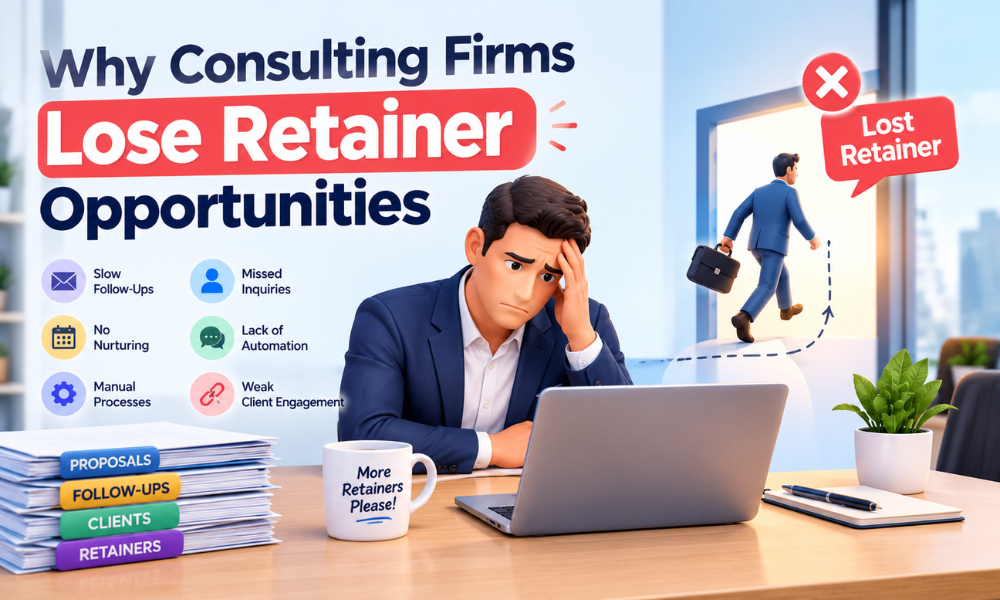
Why Consulting Firms Lose Retainer Opportunities
Consulting services often involve significant financial and operational commitments. Prospects may need to evaluate the consultant’s expertise, compare alternative solutions, obtain internal approval, or confirm that the proposed engagement aligns with business priorities.
This longer decision-making process creates several opportunities for leads to go cold.
One common problem is inconsistent follow-up. A consultant may send a proposal and become occupied with client work, forgetting to contact the prospect again. Even an interested buyer can lose momentum when communication stops.
Another problem is treating every lead identically. Someone requesting a quick consultation may be ready to book, while an executive evaluating a long-term transformation project may need detailed information and several conversations. Sending both prospects the same sequence can produce irrelevant communication.
Benefits of GoHighLevel CRM for Consulting Firms
Faster and more consistent follow-up
Speed matters when a prospect requests information or books a discovery call. A prompt response confirms that the enquiry has been received and explains what happens next.
Automated acknowledgements, appointment confirmations, and reminders help maintain consistency even during busy periods. Consultants can then focus on personalized conversations instead of repeatedly sending routine messages.
A structured workflow also reduces dependence on individual memory. If a consultant is travelling or managing several projects, the CRM can still prompt the next appropriate action.
Better lead qualification
Not every enquiry represents a suitable retainer opportunity. Some prospects may have insufficient budgets, unrealistic expectations, or requirements outside the firm’s expertise.
GoHighLevel can help collect qualifying information through forms, surveys, and conversations. Responses can be stored against the contact record and used to organize leads for further review.
For example, a marketing consultancy might qualify prospects based on business goals, current marketing activity, monthly budget, and readiness to implement recommendations. A management consultancy may prioritize organizational challenges, decision-making authority, and the expected project timeline.
Qualification should help consultants prioritize their time, not automatically reject prospects based on incomplete information. High-value opportunities may still require personal review.
Real-World GoHighLevel Automation Examples for Consulting Firms
The most effective workflows reflect actual client behaviour and sales requirements. They should have a defined purpose, relevant messages, and rules for stopping when circumstances change.
New lead enquiry and qualification workflow
When someone completes a consultation form, GoHighLevel can create or update the contact record, assign the lead to the appropriate pipeline stage, and send a confirmation message.
The prospect can receive a link to book a discovery call, along with a brief explanation of the next steps. If additional information is needed, a follow-up form can collect details about business goals, challenges, or project timelines.
If the prospect books a meeting, the system can stop the booking invitation sequence and initiate appointment reminders instead. If the lead does not respond, a short, relevant follow-up sequence can provide another opportunity to engage.
Proposal follow-up and retainer conversion
Sending a proposal does not mean the sales process is complete. Prospects may need clarification about deliverables, pricing, timelines, expected outcomes, or contract terms.
Once a proposal is sent, the CRM can schedule a task for the responsible consultant and initiate a carefully timed follow-up sequence. An initial message might ask whether the prospect has questions, while a later message could offer a short call to discuss the proposed engagement.
The workflow should account for prospect responses. If someone asks for a revised proposal, the consultant should handle that request personally. If the prospect signs the agreement, the sales follow-up should stop, and the client onboarding process should begin.
This combination of automation and human involvement can prevent qualified opportunities from being overlooked without creating unnecessary pressure.
Long-term nurturing for prospects who are not ready
Some prospects are interested in consulting services but cannot commit immediately. They may be waiting for budget approval, completing another project, or evaluating their business priorities.
Instead of repeatedly asking them to sign a retainer, the firm can use a nurturing sequence that shares useful insights, practical resources, relevant case studies, and invitations to appropriate educational events.
Messages should be tailored to the prospect’s interests and sent at a reasonable frequency. Contacts should be able to opt out, and communication must comply with applicable consent and messaging requirements.
When a prospect expresses renewed interest or books a call, the CRM can update the opportunity and notify the responsible consultant.

Using a Funnel Builder to Generate Better Consulting Leads
A GoHighLevel funnel building service can help consulting firms create a structured journey from initial interest to a booked consultation. Rather than sending every visitor to a general homepage, the firm can develop focused landing pages for specific services, audiences, or business problems.
For example, a consultancy offering operational improvement could create a landing page explaining common workflow challenges, its consulting approach, relevant evidence, and the next step for booking an assessment.
A well-designed funnel should communicate the intended audience, explain the service’s value, establish credibility, and make the next action obvious. Forms should request enough information to qualify prospects without creating unnecessary friction.
The funnel can connect directly to GoHighLevel so that submissions create or update contacts, assign opportunities, and trigger appropriate follow-up workflows. Appointment bookings can then move prospects into the next stage of the sales process.
A Funnel Builder is most effective when the landing page, offer, qualification process, and follow-up messages work together. More form submissions are not necessarily better if the resulting leads are poorly matched to the firm’s services.
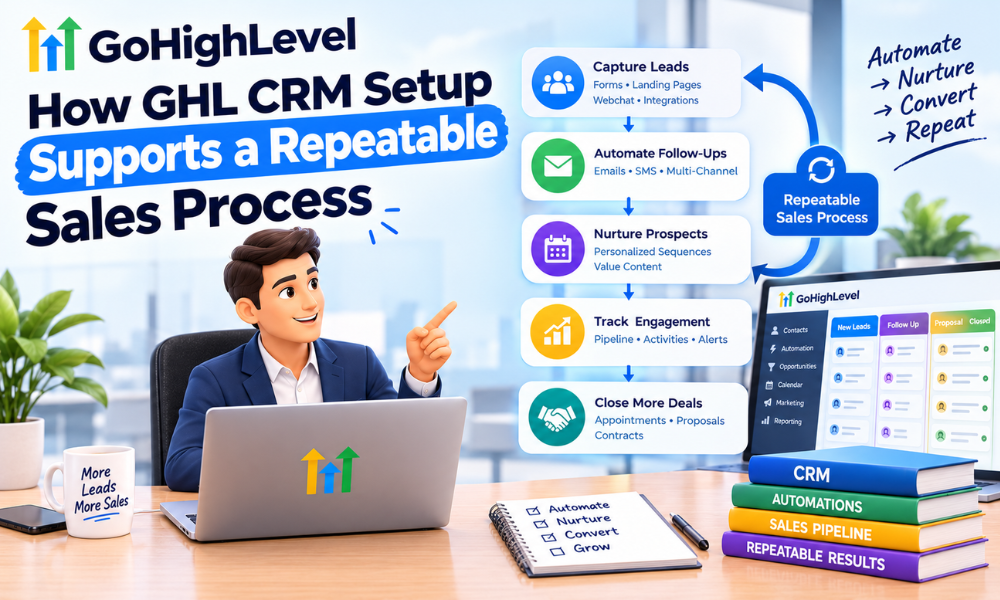
How GHL CRM Setup Supports a Repeatable Sales Process
Successful automation starts with a clear operating model. Before building workflows, consulting firms should map the steps a prospect follows from first contact to signed retainer and identify where delays commonly occur.
A reliable GHL CRM setup should include consistent pipeline stages, appropriate contact fields, lead sources, ownership rules, and clear definitions for qualified opportunities. The business should also decide who receives notifications and who is responsible for following up.
Next, workflows should be created around specific events, such as a new enquiry, a booked appointment, a missed meeting, or a proposal entering the decision stage. Each workflow needs appropriate entry conditions, exit rules, and safeguards to prevent duplicate or conflicting messages.
Test the complete journey before making it available to all leads. Use test contacts to verify that forms capture information correctly, appointments trigger the expected messages, and workflow conditions stop communication when prospects respond or convert.
Firms that need specialist implementation support may consider GoHighLevel expert services to help configure pipelines, integrations, and automation logic. The objective should be a maintainable system that reflects the firm’s real sales process rather than an unnecessarily complicated collection of workflows.
The Role of a GHL Virtual Assistant in Consulting Sales
Automation handles predictable actions, but some sales tasks still require human attention. A GHL Virtual Assistant can help manage the operational activities that keep the CRM accurate and useful.
Responsibilities may include checking new enquiries, reviewing contact records, updating pipeline stages, preparing discovery calls, monitoring unanswered messages, and notifying consultants about opportunities that require personal attention.
A virtual assistant can also help maintain the nurturing process by checking that resources are current, identifying contacts who have requested follow-up, and ensuring that workflow exceptions receive attention.
The strongest arrangement combines automation with clear human ownership. Automated systems can send routine confirmations and create reminders, while the assistant handles administrative coordination and the consultant manages qualification, proposals, negotiations, and relationship building.
A GHL Virtual Assistant should work from documented procedures and appropriate access permissions. Sensitive client information should be handled carefully, and important communications should be reviewed according to the firm’s policies.
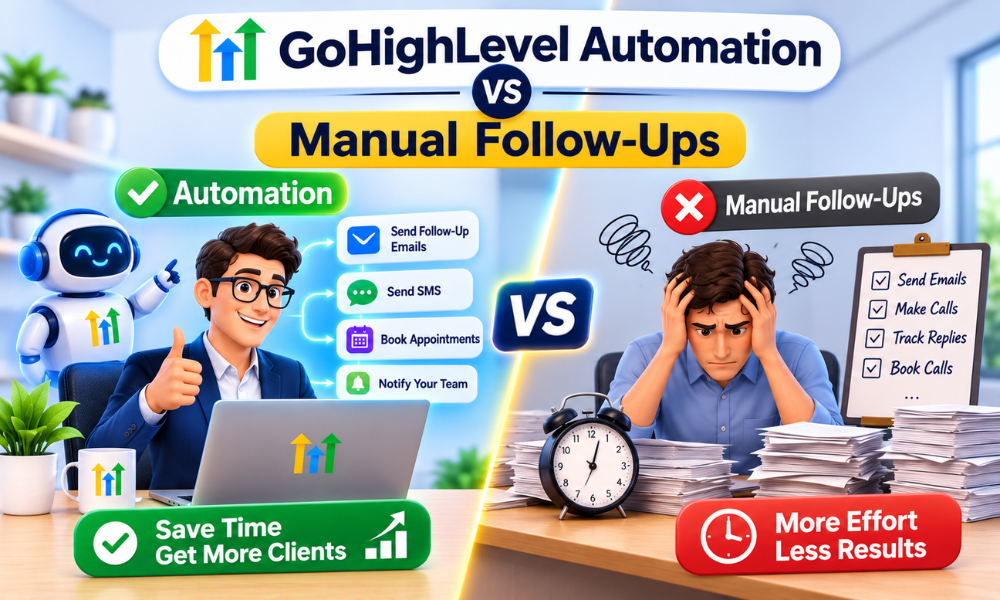
GoHighLevel Automation vs Manual Follow-Ups
Manual follow-up gives consultants flexibility to personalize every interaction, respond to complex questions, and adapt communication to the relationship. However, it becomes difficult to manage consistently as the number of leads and active proposals increases.
Automation is better suited to predictable actions, including acknowledgements, appointment reminders, task creation, and carefully timed follow-up prompts. It can help ensure that routine steps happen consistently without requiring someone to remember every detail.
Neither approach should operate in isolation. Fully manual processes can create delays and missed opportunities, while excessive automation can make prospects feel they are receiving generic messages instead of meaningful attention.
A balanced approach uses GoHighLevel automation for repetitive tasks and keeps people involved in conversations that require expertise, judgment, or negotiation. For example, an automated message can remind a prospect about a pending proposal, but the consultant should answer questions about scope, deliverables, or expected outcomes.
Businesses investing in GoHighLevel expert services should prioritize workflows that solve real operational problems and support the way their team works.
Conclusion
GoHighLevel CRM can help consulting firms build a more consistent path from new enquiry to signed retainer. By combining contact management, organized pipelines, automated reminders, proposal follow-ups, and targeted nurturing, firms can reduce administrative friction and give qualified prospects more consistent attention.
The strongest results come from a clear sales process supported by thoughtful automation. Effective GHL CRM setup, a well-designed Funnel Builder, and a capable GHL Virtual Assistant can help maintain the system, while consultants remain responsible for the personal conversations that build trust and close complex deals.
With well-planned GoHighLevel automation and the right GoHighLevel expert services, consulting firms can create a repeatable process for managing opportunities, following up professionally, and improving visibility into their sales pipeline. The goal is not to automate every interaction. It is to make sure no promising opportunity is forgotten, and every prospect receives the right next step at the right time.