
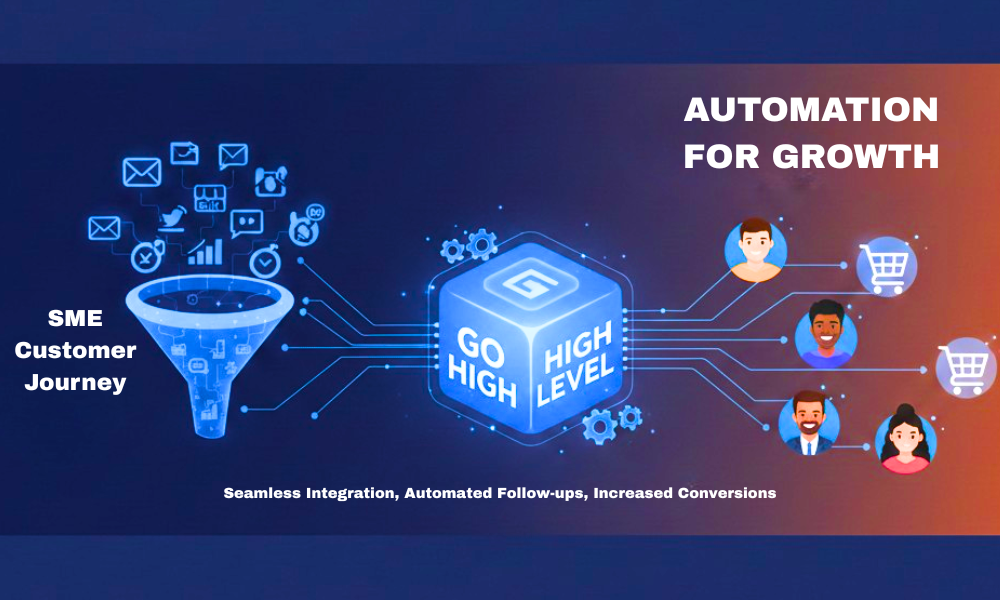
Customer Journey Automation for SMEs Using Go High Level
Why Customer Journey Automation Is No Longer Optional for SMEs
Instead, customers quietly drop off at different points in the journey:
- A lead completes a form but never receives a response
- A prospect books a call but feels unprepared
- A customer buys once and never returns
- A long-term client disengages without explanationThese losses rarely happen because of poor products or services. They happen because the customer journey is inconsistent, fragmented, or unclear.And for SMEs with limited teams and resources, managing the customer journey manually is no longer realistic.This is where customer journey automation becomes essential.What the “Customer Journey” Really Means for SMEs
It is the entire lifecycle of interaction between a business and a customer, including:
- First awareness
- Initial inquiry
- Follow-up and nurturing
- Sales conversation
- Onboarding
- Service delivery
- Retention and re-engagement
For SMEs, the challenge is not understanding these stages — it’s managing them consistently and at scale.Without automation, journeys depend on:
- Individual memory
- Manual effort
- Inconsistent follow-upsThis leads to unpredictable outcomes.The Core Problem: Fragmented Journeys Across Disconnected Tools
Most SMEs manage the customer journey across multiple platforms:
- One tool for ads
- Another for email
- A separate CRM
- Spreadsheets for tracking
- Calendars for booking
Each tool holds part of the journey — but none of them show the fully responsive picture.The result:
- Leads receive mixed messages
- Customers repeat themselves
- Teams lack visibilityFragmentation creates friction, confusion, and disengagement.Why Manual Journey Management Breaks Down
At low volume, SMEs often rely on manual processes:
- Sending follow-ups
- Booking appointments
- Updating CRM stages
- Checking in with customers
But as volume grows, manual systems fail for predictable reasons:
- People forget
- Tasks get delayed
- Context gets lost
- Quality variesManual journey management does not scale — and growth exposes its weaknesses quickly.Customer Expectations Have Changed — SME Systems Often Haven’t
Modern customers expect:
- Fast responses
- Clear communication
- Seamless transitions
- Proactive follow-upsWhen SMEs fail to meet these expectations, customers don’t complain — they leave.Why Inconsistent Journeys Erode Trust
Trust is built through:
- Reliability
- Predictability
- ProfessionalismInconsistent journeys send subtle but powerful signals:
- “This business is disorganized.”
- “They’re not paying attention.”
- “I’m not a priority.”Even small gaps — missed emails, unclear next steps, delayed follow-ups — chip away at confidence.Customer Journey Automation as a Strategic Lever
Customer journey automation is not about sending more messages. It is about designing intentional experiences that guide customers forward.Automation enables SMEs to:
- Convey the appropriate message at the optimal moment
- Ensure consistency across various channels
- Decrease dependence on manual processesWhen done correctly, automation enhances relationships instead of replacing them.Why SMEs Hesitate to Automate the Customer Journey
Despite the benefits, many SMEs delay automation because they believe:
- “We’re too small.”
- “Our business is too personal.”
- “Automation feels impersonal.”
- “We’ll do it later.”
Ironically, these same businesses struggle with: See our GHL automation services.
- Burnout
- Missed opportunities
- Stagnant growthAutomation doesn’t remove personalization — it protects it.The Cost of Ignoring the Full Journey
SMEs that focus only on lead generation or sales optimization miss the bigger picture.Without journey automation:
- Leads fall through cracks
- Customers disengage post-sale
- Retention suffers
- Lifetime value remains lowGrowth becomes expensive and unpredictable.Why SMEs Need a Unified Journey Platform
Managing the entire journey requires:
- Centralized data
- Cross-channel communication
- Automation logic
- Real-time visibilityThis is why fragmented tools fail — and unified platforms succeed.How GoHighLevel Enables End-to-End Customer Journey Automation for SMEs
Why Platform Choice Matters More Than EverCustomer journey automation requires more than isolated features. It requires a platform that connects every stage of the journey.This is where GoHighLevel stands out.GoHighLevel was built to unify:
- CRM
- Communication
- Automation
- Booking
- ReportingInto one ecosystem, making it ideal for SMEs.Mapping the Customer Journey Inside GoHighLevel
Effective automation starts with clarity.With GoHighLevel, SMEs can map:
- Lead stages
- Sales pipelines
- Customer lifecycle phasesEach stage triggers specific actions, messages, and internal workflows.Professional gohighlevel services ensure these journeys reflect real customer behavior, not theoretical funnels.
Automating the Pre-Sales Journey
Before a sale happens, customers need:
- Acknowledgment
- Information
- ReassuranceGoHighLevel automates:
- Instant lead responses
- Follow-up sequences
- Appointment reminders
- Pre-call preparation messagesThis ensures every lead experiences a consistent, professional journey — regardless of timing or volume.Sales Journey Automation Without Losing the Human Touch
Automation does not replace sales conversations — it supports them.With GoHighLevel:
- Automation pauses when humans engage
- Conversations stay contextual
- Sales teams see full interaction historyThis balance prevents robotic experiences while ensuring no lead is neglected.Post-Sale Automation: Where Most SMEs Drop the Ball
Many SMEs stop engaging once a sale is made.GoHighLevel allows automation to continue through:
- Onboarding sequences
- Welcome messages
- Expectation setting
- Check-in remindersThis reduces buyer’s remorse and increases satisfaction.Retention and Re-Engagement Automation
Long-term growth depends on retention — not constant acquisition.GoHighLevel supports:
- Customer check-ins
- Re-engagement campaigns
- Renewal reminders
- Upsell and cross-sell journeysAutomation keeps customers connected without the need for constant manual outreach.Behavior-Based Journey Automation
One of GoHighLevel’s most powerful features is behavior-based logic.Journeys can adapt based on:
- Opens and clicks
- Replies
- Bookings
- InactivityThis ensures customers receive relevant communication — not generic sequences.Centralized Communication Across the Entire Journey
GoHighLevel centralizes: Learn more about our GHL CRM setup service.
- Text Messages
- Emails
- Phone Calls
- Voicemails
- AppointmentsEvery interaction is logged, visible, and actionable.This eliminates confusion and improves internal alignment.Why Strategy Matters More Than Features
GoHighLevel is powerful — but power without direction creates complexity.SMEs that Hire gohighlevel experts benefit from:
- Strategic journey excellent design
- Clean automation logic
- Scalable systems
- Faster ROIExpert-led implementation prevents over-automation and system sprawl.Avoiding the Most Common Journey Automation Mistakes
Without expertise, SMEs often:
- Automate too aggressively
- Over-message customers
- Ignore journey transitions
- Free update workflowsProfessional gohighlevel services prevent these issues through intentional design and ongoing optimization.Measuring Journey Performance and Improving Over Time
GoHighLevel provides insight into:
- Stage conversion rates
- Drop-off points
- Engagement levelsThis data allows SMEs to:
- Improve weak stages
- Refine messaging
- Increase lifetime valueAutomation becomes a feedback loop — not a static setup.Customer Journey Automation as a Competitive Advantage
Most SMEs still manage journeys manually.Those that automate effectively:
- Respond faster
- Deliver better experiences
- Retain more customersCustomer journey automation becomes a silent differentiator.Automation Turns Experiences Into Systems
Customer experience should not depend on memory, availability, or luck.With the right platform and strategy:
- Journeys become consistent
- Teams become more effective
- Growth becomes predictableGoHighLevel provides the foundation.From Automated Touchpoints to Automated Trust — How SMEs Build Scalable Customer Journeys
Why Customer Journey Automation Is a Long-Term System, Not a One-Time Setup
One of the most common mistakes SMEs make after implementing customer journey automation is assuming the work is “done.” Workflows are built, messages are written, triggers are activated — and the system is left untouched.In reality, customer journey automation is not static.Customer behavior evolves.Markets change.Expectations increase.If automation does not evolve alongside these shifts, performance slowly degrades.High-performing SMEs understand that automation is a living system that must be continuously reviewed, refined, and optimized.The Automation Maturity Curve for SMEs
Most SMEs move through clear stages when adopting journey automation:
- Manual dependency – Everything relies on people and memory
- Task automation – Basic autoresponders and reminders
- Channel automation – Email or SMS sequences in isolation
- Journey automation – Connected, stage-based experiences
- Experience orchestration – Adaptive, data-driven journeysThe difference between stage three and stage five is strategy and expertise.This is where professional gohighlevel services become critical.Why Automating Individual Touchpoints Is Not Enough
Many SMEs automate individual moments:
- A welcome email
- A booking confirmation
- A follow-up reminder
But customers do not experience businesses in isolated moments — they experience flows.When automation is fragmented:
- Messages feel disconnected
- Timing feels random
- The journey feels disjointedTrue customer journey automation focuses on continuity, not isolated actions.
Designing Journeys Around Customer Intent, Not Internal Processes Explore our funnel builder service.
One of the biggest shifts SMEs must make is moving from internal thinking to customer-centric design.Poor journey design asks:
- “What do we want the customer to do next?”Strong journey design asks:
- “What does the customer need right now to move forward confidently?”This shift dramatically improves engagement, trust, and conversion.How GoHighLevel Supports Intent-Based Journey Design
GoHighLevel enables SMEs to build journeys that adapt based on intent signals such as:
- Engagement with messages
- Booking behavior
- Replies or silence
- Stage movement
This allows automation to:
- Accelerate ready buyers
- Nurture hesitant prospects
- Re-engage disengaged customersJourneys become responsive instead of rigid.The Importance of Automation in Alleviating Customer Anxiety
- “Did they receive my message?”
- “What happens next?”
- “Am I making the right decision?”
Automation reduces anxiety by:
- Providing immediate acknowledgment
- Setting clear expectations
- Offering proactive guidanceSMEs that reduce uncertainty outperform those that rely on reactive communication.Why Over-Automation Breaks Trust
Over-automation can undermine trust when it prioritizes efficiency over the user friendly experience.Signs of over-automation include:
- Excessive messaging
- Generic language
- Ignoring context
- Continuing automation during live conversationsOver-automation makes customers feel processed — not supported.This is why SMEs that Hire gohighlevel experts consistently achieve better outcomes: restraint is applied strategically.Human-in-the-Loop Automation: The Gold Standard
The most effective journey automation systems are human-aware.They:
- Pause when sales or support teams engage
- Resume intelligently afterward
- Surface context for human conversationsAutomation handles consistency and timing.Humans handle empathy and nuance.GoHighLevel supports this balance — but only when workflows are designed intentionally.Journey Automation Beyond Sales: The Post-Purchase Gap
Many SMEs invest heavily in pre-sale automation and neglect what happens after the sale.This creates a dangerous gap:
- Customers feel abandoned
- Value is unclear
- Retention suffers
Advanced SMEs automate:
- Onboarding education
- Success milestones
- Proactive check-insThis strengthens relationships and increases lifetime value.Customer Journey Automation as a Retention Engine
Retention is not accidental — it is designed.With GoHighLevel, SMEs can automate:
- Usage reminders
- Renewal alerts
- Re-engagement campaigns
- Feedback requestsRetention-focused automation reduces churn and stabilizes revenue.Using Journey Data to Improve Business Decisions
One of the most powerful outcomes of journey automation is visibility.SMEs gain insight into:
- Where customers disengage
- Which stages convert best
- Which messages resonateWhen paired with expert gohighlevel services, this data becomes a roadmap for improvement — not just a dashboard.The Compounding Effect of Well-Designed Journeys
Customer journey automation compounds over time.Each improvement: Book a free consultation →
- Reduces friction
- Increases clarity
- Improves experience
Over time, this leads to:
- Increased conversion rates
- Stronger retention
- Lower acquisition costsSmall refinements add up to major growth.Why DIY Journey Automation Often Plateaus
Many SMEs start strong with DIY automation but hit a ceiling.Common reasons include:
- Complexity overload
- Workflow conflicts
- Inability to adapt to edge cases
- Lack of performance analysisAt this stage, businesses often choose to Hire gohighlevel experts — not because automation failed, but because growth demands sophistication.Expertise as the Difference Between Automation and Orchestration
Automation executes tasks.Orchestration coordinates experiences.Experienced gohighlevel experts bring:
- Identify Patterns
- Key industry standards
- Established process frameworksThis shifts automation from merely supporting operations to providing a strategic edge.Customer Journey Automation as a Competitive Moat
In crowded markets, products and pricing converge.Experience becomes the differentiator.SMEs with automated, intentional journeys:
- Respond faster
- Communicate clearer
- Retain longerCompetitors struggle to replicate systems that have been built over time.Scaling Without Breaking the Journey
Growth introduces complexity:
- More segments
- More offers
- More touchpoints
Scalable journey automation:
- Uses modular workflows
- Avoids brittle logic
- Supports expansionThis allows SMEs to grow without having to rebuild systems repeatedly.Journey Automation and Brand Consistency
Consistency builds credibility.Automation ensures:
- Unified tone
- Predictable experience
- Professional communicationEvery interaction reinforces the brand — even when teams are busy.Customer Journey Automation Is About Trust at Scale
Essentially, customer journey automation focuses more on trust rather than on technology.It is about
- Showing up consistently
- Reducing friction
- Guiding customers confidentlyGoHighLevel provides the infrastructure.Gohighlevel services provide the execution.Gohighlevel experts provide the strategic lens.SMEs that Hire gohighlevel experts don’t just automate steps — they automate trust, clarity, and long-term growth.
Ready to implement this in your GHL account?
Book a free 45-minute strategy call. Our certified GoHighLevel specialists will audit your setup.
Get Your GHL Setup Done Right
Free 45-min audit call — zero cost, no commitment.
Our GHL Services
- GHL CRM Setup
- GHL Virtual Assistant
- Funnel Builder
- Automation Specialist
- White-Label SaaS
- GHL Migration
Popular Posts
- High-Converting GHL Sales Funnel
- GHL Automation Templates
- GHL Pipeline Management