

Why Customer Retention Matters for SMEs
Customer retention drives growth for small and medium-sized businesses. Acquiring new customers is more expensive than retaining existing ones, and retention drives higher profitability and more predictable revenue.
GHL for customer retention provides an efficient solution. Rather than relying solely on new lead generation, businesses use automation, CRM, and structured communication for long-term customer relationships.
This makes GHL not just a tool for managing contacts, but a structured approach to ongoing retention—setting the stage for addressing retention challenges most SMEs face next.
The Retention Problem Most SMEs Face
Many SMEs focus heavily on acquiring new customers but neglect what happens after the first sale.
Common issues include:
Lack of follow-up after purchase
Inconsistent communication
No structured retention system
Missed opportunities for repeat business
As a result, customers may forget the business or choose competitors for future needs.
Effective customer retention strategies for SMEs address these gaps by maintaining ongoing engagement.
What Is Customer Retention Automation?
Customer retention automation involves using systems to maintain communication with customers automatically over time.
Instead of manually reaching out, businesses can create workflows that automatically send messages such as follow-ups after purchases, reminders for upcoming appointments or renewals, special offers based on customer anniversaries, and helpful updates about new products or services.
These messages are triggered based on customer behavior or time intervals.
For example: After a customer makes a purchase, an automated thank-you message is sent. After 30 days, the customer receives a check-in message to see if they need additional support. After 90 days, the system triggers a special offer for repeat business. Automation ensures these touchpoints happen reliably and reduces manual workload.
How GHL CRM Supports Customer Retention
The foundation of retention is data.
GHL CRM allows businesses to centrally store and manage customer information.
This includes:
Purchase history
Communication records
Service preferences
Appointment data
With this information, businesses can personalize communication and deliver more relevant messages.
A well-organized CRM enables businesses to understand customer behavior, which sets the stage for analysis that leads to actionable retention strategies.
Building a Customer Retention System With GHL
A strong retention system includes multiple stages.
Stage 1: Post-Purchase Follow-Up
The relationship does not end after a sale.
Immediate follow-up messages show appreciation and reinforce trust.
For example:
A thank-you message
Instructions for using the product or service
Support contact information
These messages create a positive first impression.
Stage 2: Ongoing Engagement
Communicating only when there is something to sell can lead customers to disengage.
Regular engagement keeps the relationship active.
This may include:
Helpful tips
Educational content
Product updates
Industry insights
This leads naturally to another key aspect of a comprehensive retention system: re-engaging customers who may have become inactive.
Stage 3: Re-Engagement Campaigns
Some customers become inactive over time.
Customer retention automation allows businesses to reconnect with these customers.
For example:
Sending reminders about services
Offering special discounts
Sharing new updates
As we move from re-engaging lost customers, the next focus is on strengthening long-term relationships through rewards and loyalty programs.
Stage 4: Loyalty and Rewards
Rewarding customers encourages repeat business.
Retention strategies may include:
Discounts for returning customers
Exclusive offers
Loyalty programs
Now let’s look at how automation supports these loyalty and retention strategies, making them efficient and scalable.
Using Automation to Improve Retention
Automation is one of the biggest advantages of using GHL.
With GHL for customer retention, businesses can create continuous workflows.
Examples of automation include sending personalized birthday or anniversary messages to customers, automated reminders for upcoming services or appointments, alerts for subscription renewals, and requests for feedback after a completed purchase or service.
With foundational elements in place, personalization becomes the next lever in improving retention.
Personalization in Customer Retention
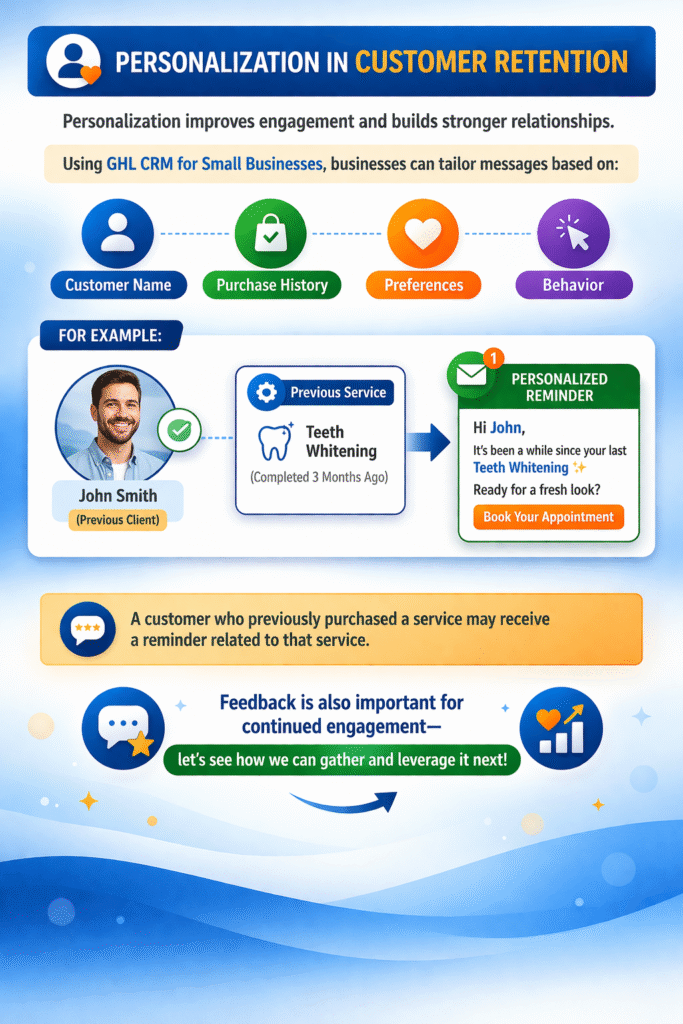
Personalization improves engagement and builds stronger relationships.
Using GHL CRM for small businesses, businesses can tailor messages based on:
Customer name
Purchase history
Preferences
Behavior
For example:
A customer who previously purchased a service may receive a reminder related to that service.
Feedback is also important for continued engagement—let’s see how we can gather and leverage it next.
Feedback and Review Collection
Customer feedback is essential for improvement.
GHL allows businesses to automate review requests after a service or purchase.
For example:
“Thank you for your recent experience. We would love your feedback.”
Positive reviews improve reputation and attract new customers.
Feedback also helps identify areas for improvement.
Appointment-Based Retention Strategies
For service-based businesses, appointments play a key role in retention.
GHL for customer retention can automate appointment reminders and follow-ups.
Examples include:
Regular maintenance reminders
Follow-up appointments
Check-in messages
With appointments optimized, combining communication channels like email and SMS broadens your retention toolkit.
Email and SMS Retention Campaigns
Combining multiple communication channels improves results.
GHL allows businesses to use:
Email campaigns for detailed communication
SMS messages for quick reminders
This multi-channel approach ensures that messages are seen and acted upon.
Tracking Retention Performance
To improve retention strategies, businesses must track performance.
Key metrics include:
Repeat purchase rate
Customer lifetime value
Engagement rates
Retention rate
With performance data, businesses are well equipped to proactively reduce churn, which is the next key retention challenge.
Reducing Customer Churn
Customer churn occurs when customers stop engaging with a business.
Common causes include:
Poor communication
Lack of follow-up
Better competitor offers
Customer retention automation helps reduce churn by maintaining consistent engagement.
Finally, as retention improves, businesses can consider scalability and ways to grow without incurring additional costs.
Why Structured Retention Systems Matter
Retention is not achieved through occasional messages.
It requires a structured system.
A well-designed system ensures that:
Every customer receives a follow-up
Communication is consistent
Opportunities are not missed
With a predictable retention process, SMEs can shift to long-term growth strategies and sustainable relationship-building.
Customer retention is a powerful growth strategy for SMEs.
Businesses that focus only on acquiring new customers often miss opportunities for long-term growth.
With GHL for customer retention, companies can build systems that maintain relationships, increase repeat purchases, and improve customer loyalty.
By combining Go High Level customer retention tools with effective customer retention strategies for SMEs, businesses can create sustainable growth systems.
As we move to more advanced retention strategies, SMEs can go from basic follow-up to full lifecycle automation.
Advanced Retention Systems, Lifecycle Automation, and Revenue Growth Frameworks
Customer retention is not just about sending occasional follow-up messages. It is about building a structured system that keeps customers engaged, satisfied, and connected to your business over time.
Most SMEs understand the importance of retention, but very few implement it effectively. The difference between businesses that retain customers and those that constantly chase new leads lies in systems.
This sets the stage for scaling retention beyond day-to-day messaging and into advanced, continuous frameworks with automation at their core.
Now, to do this effectively, businesses must understand the customer lifecycle in detail.
Understanding the Customer Lifecycle
Retention begins with understanding the full customer lifecycle.
Customers do not simply purchase once and disappear. They move through stages such as:
First interaction
First purchase
Post-purchase experience
Ongoing engagement
Repeat purchase
Advocacy
Recognizing every stage helps align communications, which is the focus of the next section on strategic alignment.
A robust retention strategy makes sure each stage is covered with timely, tailored communication—let’s explore how lifecycle-based automation achieves this.
Onboarding: The Foundation of Retention
The first experience after a purchase is critical.
Poor onboarding often leads to confusion and dissatisfaction.
A well-designed onboarding system using GHL CRM for small businesses can include:
Welcome messages
Step-by-step guidance
Product or service instructions
Support information
This ensures that customers understand how to use the product or service effectively.
Once onboarding is strong, the challenge shifts to maintaining consistent, ongoing engagement.
Creating Continuous Engagement Systems
Retention requires consistent engagement.
Customers should hear from your business regularly, but not excessively.
Using GHL for customer retention, businesses can create engagement sequences that provide ongoing value.
Examples include:
Monthly tips or insights
Product updates
Educational content
Service reminders
Next, let’s see how anticipating customer behavior can take retention results even further.
Predictive Retention Using Customer Behavior
Modern systems allow businesses to anticipate customer behavior.
By analyzing data within GHL CRM for small businesses, businesses can identify patterns such as:
Customers who have not engaged recently
Customers who frequently purchase
Customers at risk of churn
Based on this data, targeted actions can be triggered.
For example:
Inactive customers may receive re-engagement messages
Frequent customers may receive loyalty rewards
Predictive retention improves efficiency and results.
Re-Engagement Campaigns That Work
Inactive customers represent untapped opportunities.
Instead of focusing only on new leads, businesses can use customer retention automation to reactivate existing contacts.
Effective re-engagement campaigns may include:
Personalized messages
Special offers
New product updates
Exclusive content
Timing is important.
Reaching out at the right moment increases the chances of reactivation.
Building Loyalty Programs With Automation
Loyalty programs are a powerful retention tool.
However, manual management can be time-consuming.
With GHL for customer retention, businesses can automate loyalty systems.
Examples include:
Rewarding repeat purchases
Offering exclusive discounts
Providing early access to new services
Automation ensures that rewards are delivered consistently.
Loyal customers are more likely to continue engaging and referring others.
Upselling and Cross-Selling Systems
Retention is not just about keeping customers.
It is also about increasing their value.
Using Go High Level customer retention systems, businesses can introduce additional services or products at the right time.
For example:
After a purchase, customers may receive suggestions for complementary services.
Upselling and cross-selling increase revenue without requiring new customer acquisition.
Feedback Loops and Continuous Improvement
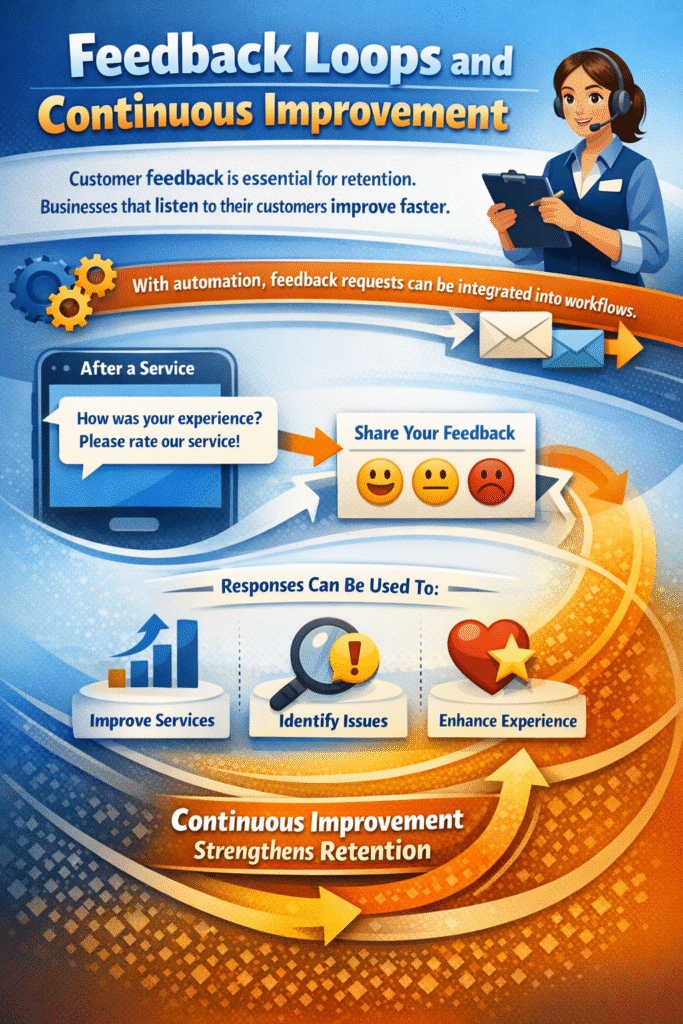
Customer feedback is essential for retention.
Businesses that listen to their customers improve faster.
With customer retention automation, feedback requests can be integrated into workflows.
For example:
After a service, customers may receive a message asking for feedback.
Responses can be used to:
Improve services
Identify issues
Enhance customer experience
Continuous improvement strengthens retention.
Automating Customer Support Communication
Support plays a major role in retention.
Delayed responses or poor communication can lead to dissatisfaction.
Using GHL CRM for small businesses, support communication can be automated.
Examples include:
Acknowledging support requests
Providing updates on issue resolution
Sharing helpful resources
Automation ensures that customers feel heard and supported.
Building Emotional Connection With Customers
Retention is not only about processes.
It is also about relationships.
Customers are more likely to stay with businesses they trust and feel connected to.
Simple gestures can make a difference.
Examples include:
Personalized messages
Anniversary greetings
Appreciation notes
These small interactions strengthen emotional connections.
Creating Omnichannel Retention Systems
Customers interact with businesses through multiple channels.
An effective customer retention strategy for SMEs integrates communication across:
Email
SMS
CRM messaging
Social media
For example:
A customer may receive an email update and an SMS reminder.
Omnichannel communication increases engagement and ensures consistency.
Tracking Retention Metrics for Growth
Data-driven decision-making is essential for scaling retention.
Businesses should track metrics such as:
Customer retention rate
Repeat purchase frequency
Customer lifetime value
Engagement rates
These metrics provide insights into performance.
For example:
If retention rates are low, onboarding may need improvement.
If repeat purchases are high, loyalty programs may be effective.
Reducing Dependency on New Customer Acquisition
Many SMEs rely heavily on acquiring new customers.
However, this approach is costly and unsustainable.
Retention-focused businesses achieve growth more efficiently.
With GHL for customer retention, businesses can:
Maximize existing relationships
Increase customer lifetime value
Reduce marketing costs
This creates a more stable growth model.
Scaling Retention Systems With Automation
As businesses grow, manual retention efforts become difficult to manage.
Automation allows retention systems to scale.
With customer retention automation, businesses can:
Handle large customer bases
Maintain consistent communication
Reduce operational workload
This ensures that growth does not compromise customer experience.
Aligning Retention With Business Goals
Retention strategies should align with overall business objectives.
For example:
If the goal is recurring revenue, focus on subscription models.
If the goal is referrals, focus on customer satisfaction and advocacy.
Alignment ensures that retention contributes directly to growth.
The Long-Term Impact of Retention Systems
Over time, strong retention systems create compounding benefits.
Customers stay longer
Revenue becomes more predictable
Marketing costs decrease
Brand reputation improves
This long-term impact is what makes Go High Level’s customer retention systems so valuable.
Customer retention is no longer optional for SMEs.
It is a critical component of sustainable growth.
Businesses that rely solely on new customer acquisition face rising costs and greater uncertainty.
With GHL for customer retention, companies can build structured systems that maintain relationships, improve engagement, and increase revenue.
By combining:
Lifecycle-based communication
Data-driven insights
Automated workflows
Personalized engagement
SMEs can create powerful retention systems.
Using GHL CRM for small businesses and advanced customer retention automation, businesses can transform one-time customers into long-term relationships.