

Choosing the Right Growth Platform as an SME
For small and medium-sized businesses, selecting the right CRM and marketing automation platform is not just a software decision. It is a growth decision.
Two names frequently appear in that conversation:
GoHighLevel and HubSpot.
Both platforms promise:
Marketing automation
CRM capabilities
Pipeline tracking
Lead management
Campaign tools
But for SMEs, the real question is not which platform is more famous.
The real question is:
Which platform aligns better with your operational structure, budget, and scalability goals?
At gohighlevelexpertservices, we help SMEs evaluate platforms based on practical performance, not branding perception. This deep dive explores where each platform excels and where it may create friction.
Platform Philosophy: All-in-One vs Enterprise Ecosystem
The first major difference lies in philosophy.
HubSpot was built as a scalable, modular ecosystem designed primarily for growing companies that may eventually operate at enterprise scale.
GoHighLevel was built as an all-in-one marketing and sales operating system, especially attractive to agencies and SMEs seeking consolidated functionality.
HubSpot emphasizes layered expansion.
GoHighLevel emphasizes operational consolidation.
For SMEs with lean teams, consolidation often reduces complexity.
Pricing Structure and Budget Predictability
One of the most significant differences for SMEs is cost structure.
HubSpot typically uses tiered pricing across:
Marketing Hub
Sales Hub
Service Hub
Operations Hub
As features expand, monthly costs can increase significantly.
GoHighLevel offers broader feature access under simplified pricing tiers, making forecasting easier.
SMEs with limited budget flexibility often find cost predictability critical.
This is one reason many businesses eventually hire gohighlevel professionals to evaluate whether consolidation into GHL reduces operational overhead.
CRM Depth and Pipeline Management
HubSpot’s CRM is mature and widely adopted. It offers strong reporting capabilities and structured sales tracking.
However, for many SMEs, the complexity can feel overwhelming if not fully configured.
GoHighLevel provides flexible pipeline creation and automation tied directly to stage movement.
For businesses that require fast implementation and tight alignment with automation, GHL often feels more adaptable.
When improperly structured, both platforms can become cluttered.
That is why SMEs frequently hire experienced gohighlevel specialists to intentionally build pipelines rather than rely on default setups.
Marketing Automation Capabilities
HubSpot’s automation engine is powerful, particularly at higher pricing tiers.
However, advanced workflows often require premium plans.
GoHighLevel integrates automation deeply across:
Email
SMS
Pipelines
Forms
Surveys
Calendars
For SMEs running lean teams, having automation centralized simplifies management.
Operational simplicity often matters more than feature volume.
Funnel Building and Landing Pages
HubSpot provides landing page builders, but design flexibility and customization often require development expertise.
GoHighLevel includes funnel and page builders within a single ecosystem, enabling faster deployment.
For SMEs launching campaigns frequently, speed to execution becomes critical.
When built strategically, GHL funnels can incorporate Excellent designs while maintaining performance efficiency.
Speed matters when marketing teams are small.
Customization vs Usability
HubSpot offers extensive customization but may require onboarding investment.
GoHighLevel focuses on usability and rapid deployment.
For SMEs without large technical teams, platforms must feel user-friendly while still offering depth.
The wrong setup can make either system confusing.
This is why many growing businesses hire gohighlevel experts to ensure systems are structured clearly from the beginning.
Mobile Performance and Accessibility
Modern teams operate across devices.
Both platforms provide mobile functionality, but execution matters more than availability.
GHL funnels and forms can be configured to remain fully responsive across devices when built properly.
HubSpot’s mobile CRM access is strong, but front-end page performance depends heavily on configuration.
Mobile usability affects adoption and conversion rates.
Integration Ecosystem
HubSpot has an expansive integration marketplace.
For businesses already embedded in complex software stacks, this ecosystem can be beneficial.
GoHighLevel supports integrations as well, but it emphasizes reducing dependency on external tools by offering native functionality.
SMEs that prefer fewer tools and centralized control often gravitate toward GHL.
Those that operate within enterprise tech stacks may prefer HubSpot’s broader integration library.
Reporting and Analytics
HubSpot’s reporting dashboards are advanced and visually structured.
However, many advanced reports require upgraded tiers.
GoHighLevel offers pipeline and automation reporting directly tied to operational workflows.
For SMEs focused primarily on:
Lead-to-close tracking
Campaign performance
Pipeline forecasting
GHL’s reporting often provides sufficient clarity without additional complexity.
Businesses that hire goHighLevel frequently prioritize structured pipeline reporting over decorative dashboards.
Learning Curve and Implementation
HubSpot often requires a structured onboarding process to unlock its full potential.
GHL can be implemented faster, but an incorrect setup can limit performance.
The deciding factor is not which platform is easier.
It is whether the system aligns with your internal processes.
SMEs without dedicated operations teams frequently hire gohighlevel experts to prevent misalignment during setup.
Scalability Considerations
HubSpot is often viewed as more enterprise-ready.
However, many SMEs do not require the complexity of an enterprise.
GoHighLevel supports scaling through automation and structured pipelines while maintaining cost efficiency.
As GHL continues to introduce free updates, feature improvements enhance long-term viability without forcing immediate price increases.
Scalability must be evaluated based on actual growth trajectory, not hypothetical future needs.
Agency and Multi-Client Use
For agencies managing multiple clients, Go High Level vs HubSpot offers distinct advantages through account segmentation and white-label capability.
HubSpot supports multi-account management, but it can rapidly increase costs.
SMEs operating as agencies often find GHL’s architecture more aligned with their structure.
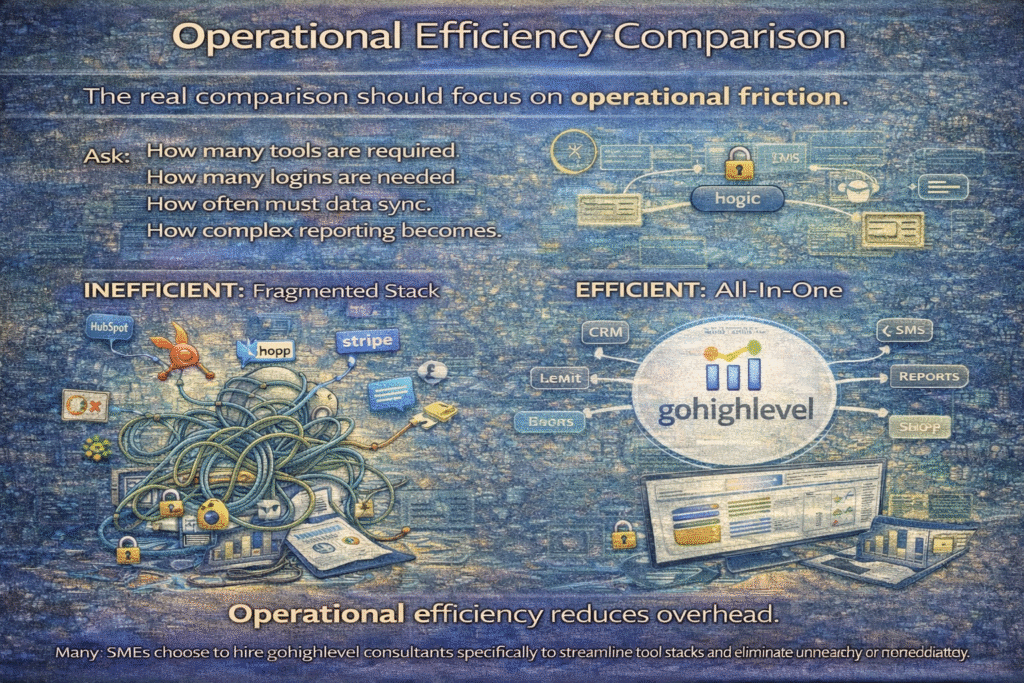
Operational Efficiency Comparison
The real comparison should focus on operational friction.
Ask:
How many tools are required
How many logins are needed
How often must data sync
How complex reporting becomes
Operational efficiency reduces overhead.
Many SMEs choose to hire gohighlevel consultants specifically to streamline tool stacks and eliminate unnecessary software redundancy.
When HubSpot May Be the Better Fit
HubSpot may be appropriate when:
You require deep enterprise integrations
You operate with a large internal marketing team
You prioritize advanced enterprise analytics
You anticipate rapid global scaling
In such cases, the investment may justify complexity.
When GoHighLevel May Be the Better Fit
GHL often suits SMEs when:
You want consolidated tools
You need cost predictability
You rely heavily on automation
You operate with lean teams
You prioritize rapid deployment
For these businesses, the all-in-one structure reduces friction.
The Real Decision Framework
The decision should not be based on brand recognition.
It should be based on:
Operational alignment
Budget structure
Team capacity
Growth goals
Tool stack preference
At HubSpot vs Go High Level, we guide SMEs through structured evaluations before recommending migration.
Many businesses initially assume HubSpot is the default choice until they carefully analyze their operational requirements.
Why Expert Guidance Matters
Both platforms can underperform when poorly implemented.
Common issues include:
Overlapping workflows
Unclear pipelines
Inconsistent data entry
Disconnected automation
Businesses that hire gohighlevel professionals avoid costly restructuring later.
Expert setup ensures:
Clean architecture
Automation clarity
Reporting accuracy
Long-term scalability
The platform matters less than how it is implemented.
The Right Platform Is the One You Can Operate Well
There is no universal winner.
There is only operational fit.
HubSpot offers enterprise depth and ecosystem breadth.
GoHighLevel offers consolidation, automation, and centralization, and SME-focused efficiency.
For many growing SMEs, clarity, cost predictability, and streamlined systems outweigh the complexity of the enterprise.
At gohighlevelexpertservices, our role is not to blindly promote one platform.
It is to ensure that whichever system you choose is structured to support predictable revenue growth.
And for businesses that choose GHL, hiring goHighLevel experienced experts ensures that the platform becomes a growth engine rather than just another tool.
Implementation Complexity: What SMEs Often Underestimate
Both HubSpot and GoHighLevel require structured onboarding.
However, the type of complexity differs.
HubSpot complexity often comes from:
Layered modules
Tiered feature access
Advanced customization options
Enterprise-style workflows
GoHighLevel complexity usually comes from:
Automation architecture
Pipeline logic design
Conditional workflows
Account segmentation
Neither system is “plug and play” if you want serious results.
That is why many SMEs ultimately hire gohighlevel professionals to ensure architecture clarity from day one.
Sales Team Adoption: The Real Test
A CRM is only valuable if your sales team uses it consistently.
HubSpot adoption can struggle when:
The interface feels overwhelming
Too many fields exist
Reporting expectations are unclear
Customization becomes excessive
GoHighLevel adoption can struggle when:
Pipelines lack clear stage definitions
Automation fires inconsistently
Users lack training on workflow logic
Adoption depends on simplicity and clarity.
Businesses that hire Go High Level vs HubSpot comparison often focus first on behavioral alignment before adding advanced automation layers.
Automation Depth: Enterprise Logic vs Practical Efficiency
HubSpot allows extremely detailed automation, especially at higher tiers.
However, advanced automation can:
Increase configuration time
Require technical support
Raise monthly costs
GoHighLevel integrates automation across marketing and sales by default.
For SMEs, the difference lies in accessibility.
GHL automation is powerful but more immediately actionable for lean teams.
The deciding factor should be this:
Do you need enterprise complexity or operational efficiency?
Data Ownership and Portability
Data control matters.
HubSpot’s ecosystem is structured and scalable, but migration away from it can become complex once deeply embedded.
GoHighLevel offers centralized control with strong export capability.
For SMEs that anticipate growth shifts or agency collaboration, flexibility can be a major consideration.
Businesses frequently hire goHighLevel consultants when migrating from HubSpot to GHL because the architecture must be rebuilt carefully to preserve data integrity.
Migration Considerations: From HubSpot to GHL
Migrating from HubSpot to GoHighLevel involves:
Contact export
Pipeline recreation
Workflow rebuilding
Email template transfer
Automation mapping
The biggest challenge is not data transfer.
It is a process translation.
HubSpot workflows must be redesigned within GHL’s automation framework.
Without structured planning, migration creates operational downtime.
This is one of the most common reasons businesses hire goHighLevel experts during transition.
Reporting Philosophy: Presentation vs Practicality
HubSpot dashboards are polished and presentation-friendly.
They often serve executive reporting well.
GoHighLevel dashboards focus more directly on:
Pipeline stages
Opportunity tracking
Automation results
For SMEs, decision-making speed often matters more than dashboard aesthetics.
Choose based on how frequently reports are used for strategic decisions versus stakeholder presentations.
Marketing Team Workflow Efficiency
HubSpot’s marketing suite supports large content teams and advanced campaign segmentation.
However, smaller teams may find it heavier than necessary.
Go High Level or HubSpot for small business centralizes:
Funnels
Email campaigns
SMS
Calendars
Forms
This reduces tool switching.
For SMEs managing campaigns with limited staff, operational simplicity often outweighs deeper segmentation.
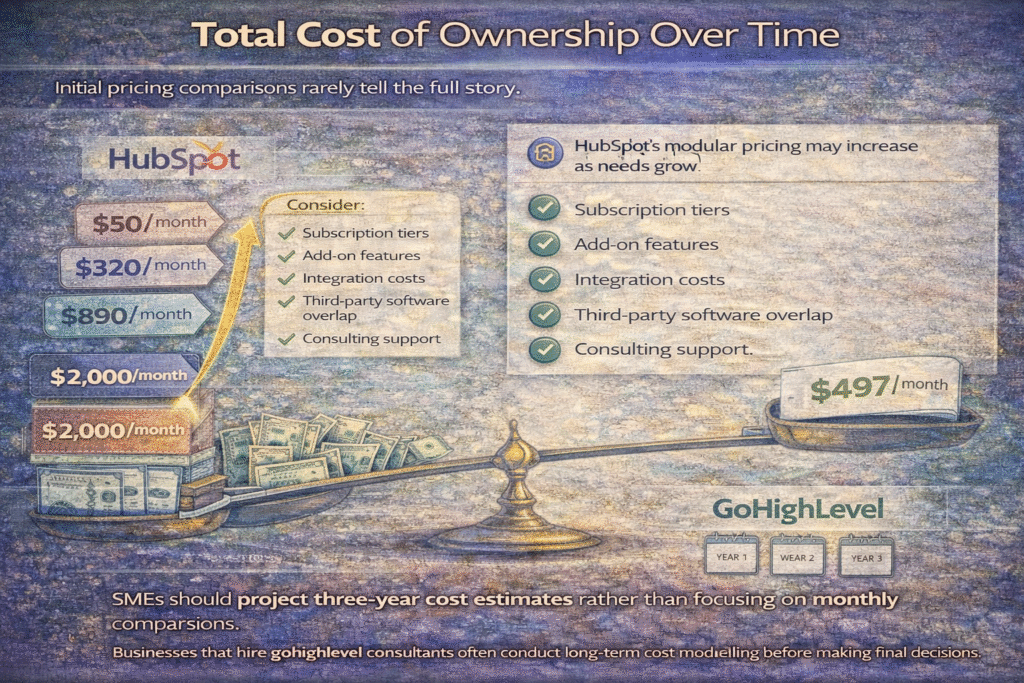
Total Cost of Ownership Over Time
Initial pricing comparisons rarely tell the full story.
Consider:
Subscription tiers
Add-on features
Integration costs
Third-party software overlap
Consulting support
HubSpot’s modular pricing may increase as needs grow.
GoHighLevel’s consolidated pricing may reduce reliance on separate tools.
SMEs should project three-year cost estimates rather than focusing on monthly comparisons.
Businesses that hire gohighlevel consultants often conduct long-term cost modeling before making final decisions.
White Label and Agency Flexibility
HubSpot supports partner programs but is not built primarily for white-label agency scaling.
GoHighLevel offers white-label capabilities natively.
For SMEs operating as agencies or planning to serve multiple clients, this distinction becomes significant.
Platform flexibility should match the business model.
Automation Risk Management
Automation can create growth leverage.
It can also create chaos.
Common risks include:
Duplicate workflows
Conflicting triggers
Overlapping email sequences
Incorrect pipeline stage movement
Both platforms require structured governance.
At gohighlevelexpertservices, we emphasize automation mapping before execution.
Businesses that hire experienced GoHighLevel employees significantly reduce long-term cleanup costs.
Customization vs Standardization
HubSpot allows deep customization of properties and workflows.
GoHighLevel allows flexible configuration within a centralized architecture.
Customization can be powerful.
But over-customization increases maintenance complexity.
SMEs benefit from standardization unless business models are highly specialized.
Strategic restraint often improves long-term stability.
Scalability and Future Growth
Scalability depends on:
User volume
Automation complexity
Reporting demands
Geographic expansion
HubSpot may scale naturally for enterprise transitions.
GoHighLevel scales effectively for operational automation-heavy businesses.
The key is forecasting realistic growth scenarios.
Choosing a system based on hypothetical enterprise growth may create unnecessary cost and complexity.
Training and Support Ecosystem
HubSpot offers structured training certifications and documentation.
GoHighLevel’s support is evolving rapidly, with strong community resources.
However, structured implementation guidance often matters more than the volume of documentation.
Many SMEs prefer to hire CRM for startups and SMEs specialists rather than rely solely on tutorials, especially when revenue systems are at stake.
Decision-Making Framework for SMEs
Before choosing between GHL and HubSpot, ask:
Do we prioritize operational simplicity or enterprise depth
Do we have a large marketing team or lean operators
Is cost predictability critical
How much automation complexity do we require
Will we manage multiple client accounts
Clear answers simplify selection.
The Cost of Delayed Optimization
Some SMEs delay platform decisions.
They remain on partial setups.
They operate hybrid systems.
They rely on spreadsheets to fill gaps.
This fragmentation increases operational risk.
Choosing a platform is important.
Structuring it properly is even more important.
Businesses that hire gohighlevel experience early avoid the cost of rebuilding later.
Why Implementation Strategy Matters More Than Platform Brand
The most important truth in this comparison is simple:
A well-implemented system outperforms a popular one.
Both HubSpot and GoHighLevel can:
Generate leads
Automate follow-up
Track pipelines
Report revenue
The difference lies in structure.
At gohighlevelexpertservices, we frequently see businesses blame software when the real issue is architecture.
Implementation determines performance.