

When Too Many Tools Become the Real Bottleneck
Most SMEs don’t struggle because they lack software.
They struggle because they have too much of it.
Over the years, small and medium-sized businesses slowly accumulate tools:
- One for CRM
- One for email marketing
- One for SMS
- One for booking
- One for funnels
- One for automation
- One for reporting
- Each tool solves a small problem—but together, they create a fragile, expensive, and disconnected system.
At GoHighLevel Expert Services, we see this pattern constantly:
Businesses spend more time managing tools than managing growth.
This is where replacing multiple tools with a single, unified platform becomes not just convenient—but strategic.
Why Tool Sprawl Is One of the Biggest Hidden Problems for SMEs
Tool Sprawl Creates Operational Friction
When tools don’t talk to each other:
- Data gets duplicated
- Leads fall through cracks
- Teams lose context
- Automation breaks
Simple actions require manual handoffs.
What should take seconds takes minutes.
What should be automatic requires effort.
This friction compounds daily.
Multiple Tools Create Invisible Costs
SMEs often focus on subscription prices, but the real cost includes:
- Setup time
- Integration maintenance
- Training staff on multiple systems
- Debugging when something breaks
Even “cheap” tools become expensive when stacked together.
Fragmented Systems Destroy Visibility
When data lives in five different platforms, it’s impossible to answer basic questions confidently:
- Where did this lead come from?
- What stage is this prospect in?
- Who followed up last?
- What actually converted?
Decisions become guesses instead of strategies.
More Tools = More Failure Points
Every extra tool adds:
- Another login
- Another integration
- Another dependency
When one breaks, the entire workflow can fail silently.
SMEs don’t usually discover this until revenue is already impacted.
Why SMEs Initially Add More Tools Instead of Replacing Them
Most businesses don’t plan tool sprawl—it happens reactively.
Common reasons include:
- “We just need this one feature.”
- “This tool integrates with what we already use.”
- “We’ll clean it up later.”
But “later” rarely comes—until the system becomes unmanageable.
The Shift From Tool Stacking to Platform Thinking
Modern growth doesn’t come from stacking more tools.
It comes from platform thinking:
- Fewer tools
- Deeper integration
- Centralized data
- Unified workflows
This is exactly where GoHighLevel changes the game.
What GoHighLevel Actually Replaces (In Real Terms)
GoHighLevel is often described as “all-in-one,” but that phrase can sound vague. Let’s be concrete.
Replacing Standalone CRMs
Instead of:
- One CRM for contacts
- Another system for sales tracking
GoHighLevel provides: - Centralized contact management
- Visual pipelines
- Full interaction history
Everything lives in one record—no syncing required.
Replacing Email & SMS Marketing Tools
Instead of:
- Email platforms
- SMS platforms
- Separate automation tools
GoHighLevel combines: - Email campaigns
- SMS workflows
- Multi-channel follow-ups
- Behavior-based automation
Messaging becomes coordinated instead of fragmented.
Replacing Booking & Scheduling Tools
Instead of:
- Third-party schedulers
- Manual calendar coordination
GoHighLevel offers: - Built-in calendars
- Automated confirmations
- Reminder sequences
- No-show reduction workflows
Booking becomes frictionless and fully responsive.
Replacing Funnel & Landing Page Builders
Instead of:
- Funnel builders
- Form tools
- Page hosting platforms
GoHighLevel provides: - Funnel creation
- Forms & surveys
- Integrated tracking
- Native automation triggers
No external connectors required.
Replacing Call Tracking & Missed-Call Systems
Instead of:
- Separate call tracking software
- Manual follow-ups for missed calls
GoHighLevel enables: - Call tracking
- Call routing
- Missed-call text-back automation
Calls stop being blind spots.
Replacing Workflow & Automation Tools
Instead of:
- Zapier-heavy setups
- Multiple automation platforms
GoHighLevel allows: - Native workflows
- Conditional logic
- Pipeline-based automation
Fewer integrations = fewer points of failure.
Replacing Reporting Dashboards
Instead of:
- Exporting data
- Stitching reports manually
GoHighLevel gives: - Real-time pipeline metrics
- Lead source attribution
- Performance visibility in one place
Decisions become data-driven, not assumption-based.
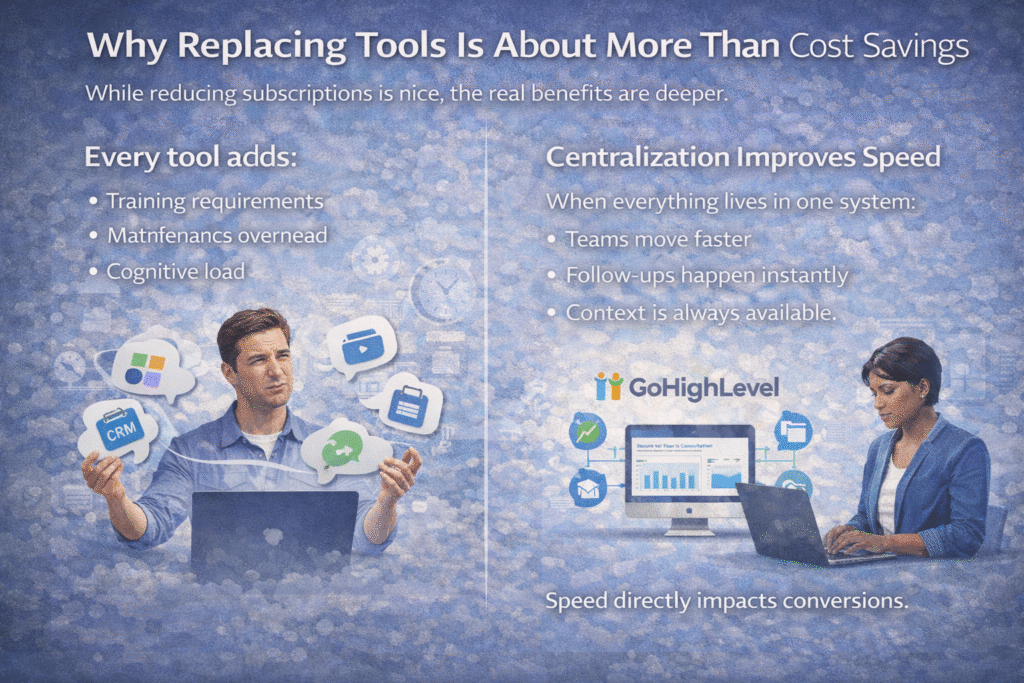
Why Replacing Tools Is About More Than Cost Savings
While reducing subscriptions is nice, the real benefits are deeper.
Centralization Improves Speed
When everything lives in one system:
- Teams move faster
- Follow-ups happen instantly
- Context is always available
Speed directly impacts conversions.
Consistency Improves Trust
Unified systems ensure:
- Consistent messaging
- Predictable experiences
- Clear next steps
Customers free updates professionalism—even if your team is small.
Simplicity Improves Adoption
Teams resist complexity.
When systems are simple:
- Training time drops
- Errors decrease
- Accountability improves
A tool only creates value if people actually use it.
Fewer Tools Improve Scalability
Growth exposes system weaknesses.
Unified platforms scale better because:
- Logic is centralized
- Data stays clean
- Changes propagate correctly
Stacked tools break under pressure.
Why Some SMEs Fail When Consolidating Tools
Replacing multiple tools isn’t just about switching software—it’s about system excellent design.
Common mistakes include:
- Migrating bad processes into a new platform
- Recreating old complexity inside GoHighLevel
- Over-automating too quickly
- Ignoring user experience
This is why expert-led consolidation matters.
How to Approach Tool Replacement the Right Way
At GoHighLevel Expert Services, we follow a structured approach:
Step 1: Audit Existing Tools and Workflows
Understand what each tool actually does—and whether it’s still needed.
Step 2: Identify Redundancies
Most SMEs are paying twice (or more) for overlapping functionality.
Step 3: Redesign the System, Not Just the Stack
Fix broken workflows instead of recreating them.
Step 4: Migrate in Phases
Avoid “big bang” migrations that disrupt operations.
Step 5: Optimize After Consolidation
Use GoHighLevel’s full power instead of stopping at basic setup.
The Psychological Benefit of Fewer Tools (Often Overlooked)
When SMEs reduce tools:
- Mental load decreases
- Decision fatigue drops
- Teams feel in control again
Clarity improves performance.
This alone often justifies consolidation.
Replacing Tools Also Reduces Vendor Risk
Every tool vendor:
- Changes pricing
- Changes policies
- Changes features
Relying on too many vendors increases exposure.
A unified platform reduces dependency and uncertainty.
When Replacing Tools Makes the Biggest Impact
SMEs benefit most when they:
- Are growing but feeling operational strain
- Have multiple disconnected tools
- Are missing leads or follow-ups
- Want to scale without hiring
This is usually the tipping point.
Fewer Tools, Better Systems, Stronger Growth
Growth doesn’t come from having more software.
It comes from having better systems.
Replacing multiple tools with GoHighLevel:
Simplifies operations
Improves visibility
Reduces cost and complexity
Creates a scalable foundation
But the real value lies in how the platform is implemented—not just in its adoption.
At GoHighLevelExpertServices, we help SMEs replace chaos with clarity by designing GoHighLevel systems that actually support growth—not just look impressive on paper.
Because the goal isn’t fewer tools.
The goal is a business that runs smoothly, predictably, and profitably.
How to Replace Multiple Tools With Go High Level Without Breaking Your Business
Why Tool Replacement Is a Business Transformation, Not a Software Swap
One of the most common misconceptions SMEs have is that replacing multiple tools with a single platform is a technical exercise.
In reality, it is an operational transformation.
Every tool you currently use supports:
A workflow
A habit
A decision-making pattern
A team behavior
When tools change, those behaviors must change too.
This is why many SMEs struggle—not because GoHighLevel is difficult, but because they try to replace tools without redesigning how work flows through the business.
Why “Lift-and-Shift” Migrations Fail
A lift-and-shift migration means:
- Taking existing tools
- Recreating the same workflows
- Dropping them into a new platform
This approach almost always fails.
Why?
Most SMEs are already running inefficient, fragmented systems. Copying those inefficiencies into GoHighLevel simply recreates the same problems—just in a new interface.
Successful consolidation requires intentional simplification.
Step 1: Identify What Each Tool Actually Does (Not What You Think It Does)
Before replacing anything, SMEs must conduct an honest audit of their current stack.
For each tool, ask:
- What problem does this tool solve?
- How often is it actually used?
- Which workflows depend on it?
- What breaks if it disappears tomorrow?
You’ll often discover: - Redundant features across tools
- Tools used by habit, not necessity
- Paid features that are never touched
This clarity prevents unnecessary complexity during migration.
Step 2: Separate “Must-Have” Functions From “Nice-to-Have” Features
Most tool stacks grow because of edge cases.
An SME adds a tool for:
- One campaign
- One client request
- One internal preference
Over time, these edge cases become permanent overhead.
When consolidating into GoHighLevel, SMEs should focus on: - Core revenue workflows
- Primary customer journeys
- Critical internal operations
Edge cases can be handled later—or eliminated entirely.
Step 3: Redesign Workflows for a Unified Platform
GoHighLevel works best when workflows are end-to-end, not stitched together.
Instead of:
- Tool A → Tool B → Tool C
You design: - One trigger
- One centralized logic path
- One source of truth
Examples: - A lead submits a form → CRM update → follow-up automation → pipeline movement
- A missed call → SMS response → booking → reminder → sales task
This cohesion effectively replaces multiple tools.
Step 4: Migrate in Phases, Not All at Once
One of the biggest mistakes SMEs make is trying to replace everything simultaneously.
This creates:
- Operational risk
- Team confusion
- Revenue disruption
A smarter approach:
- Migrate lead capture and follow-up first.
- Replace booking and calendars next.
- Consolidate CRM and pipelines.
- Move reporting and analytics last.
Each phase should stabilize before the next begins.
Step 5: Run Parallel Systems Temporarily (With Clear Boundaries)
In many cases, it’s smart to:
- Keep old tools active briefly
- Run GoHighLevel in parallel
- Gradually shift traffic and workflows
But this only works if boundaries are clear: - Which system is authoritative?
- Which data is final?
- When does the old tool get shut off?
Parallel systems without discipline create confusion.
Step 6: Train Teams on “Why,” Not Just “How”
Tool replacement fails when teams only learn buttons and screens.
Teams must understand:
- Why workflows changed
- What problems the new system solves
- How their role becomes easier
When teams see GoHighLevel as a simplification, adoption increases naturally.
When they see it as “another tool,” resistance grows.
Step 7: Expect Temporary Friction (and Plan for It)
Even the best migrations create short-term friction:
- Learning curves
- Missed steps
- Small errors
This is normal.
What matters is: - Clear ownership
- Fast iteration
- Willingness to refine
SMEs that expect a “perfect switch” often panic and revert prematurely.
Step 8: Use Consolidation to Enforce Better Discipline
Replacing multiple tools is an opportunity to fix:
- Poor lead hygiene
- Inconsistent follow-ups
- Sloppy pipeline management
- Unclear accountability
GoHighLevel makes processes visible.
Visibility creates accountability—and accountability improves performance.
Why Centralization Improves Decision-Making
When all activity lives in one system:
- Data becomes trustworthy
- Patterns become visible
- Decisions become faster
Instead of asking: - “Which tool has the right data?”
Teams ask: - “What does the system tell us?”
This shift alone can change how SMEs operate.
The Hidden ROI of Tool Consolidation
Beyond cost savings, SMEs gain:
- Faster response times
- Higher conversion rates
- Fewer missed opportunities
- Less internal confusion
These gains compound over time.
Many businesses discover that consolidation improves performance even without increasing traffic or spend.
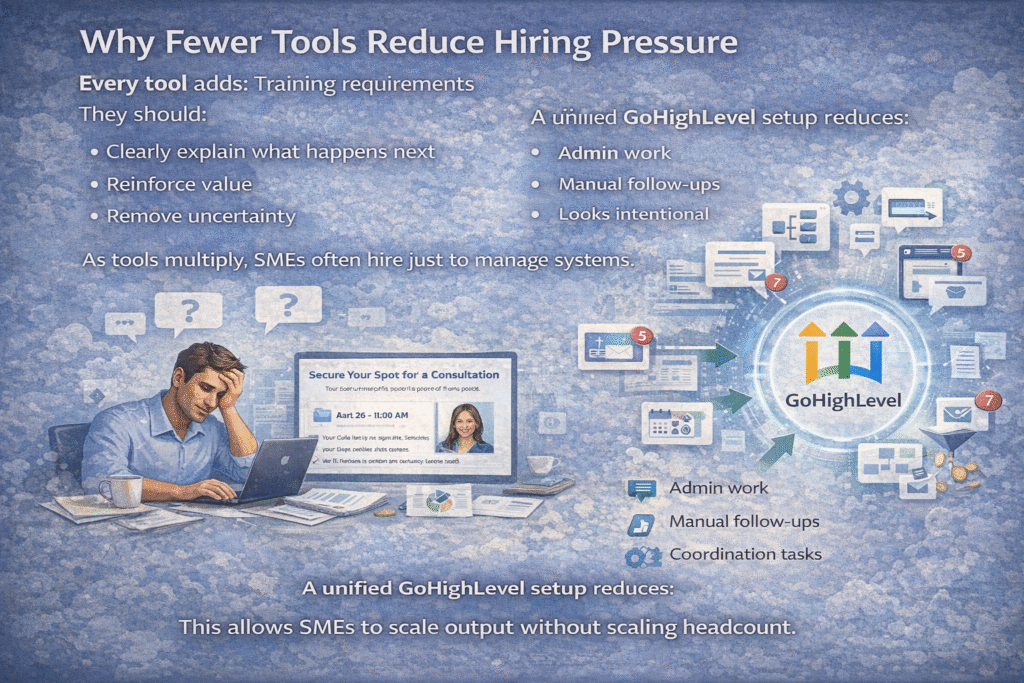
Why Fewer Tools Reduce Hiring Pressure
Every tool adds:
- Training requirements
- Maintenance overhead
- Cognitive load
As tools multiply, SMEs often hire just to manage systems.
A unified GoHighLevel setup reduces: - Admin work
- Manual follow-ups
- Coordination tasks
This allows SMEs to scale output without scaling headcount.
Avoiding the “Everything-in-One-Monster” Problem
Some SMEs overcorrect by stuffing everything into GoHighLevel without structure.
This leads to:
- Overlapping workflows
- Conflicting logic
- Automation chaos
The goal is not to use every feature—it’s to user friendly the right features well.
Expert-led implementations focus on restraint, not excess.
Long-Term System Health After Consolidation
Once tools are replaced, the work isn’t done.
Healthy GoHighLevel systems require:
- Periodic audits
- Workflow cleanup
- Performance reviews
- Asset archiving
This prevents system decay and protects long-term ROI.
Why Many SMEs Rebuild Instead of Optimizing
A common pattern:
- DIY consolidation
- Partial success
- Growing complexity
- Performance plateau
- Full rebuild later
This is costly and avoidable.
The difference between rebuilds and optimization is the quality of the architecture at the start.
Consolidation as a Competitive Advantage
Most SMEs still operate with:
- Fragmented tools
- Slow follow-up
- Inconsistent experiences
Businesses that consolidate effectively: - Respond faster
- Look more professional
- Operate with clarity
- Scale with confidence
Over time, this operational advantage becomes difficult to compete with.
When Consolidation Is the Wrong Move (Rare, but Real)
In rare cases, consolidation should be delayed if:
- Core processes are undefined
- Leadership alignment is missing
- No one owns system health
In these cases, groundwork must come first.
GoHighLevel amplifies clarity—but it cannot create it from chaos.
Replace Tools to Simplify, Not to Show Off
Replacing multiple tools with GoHighLevel is not about:
- Having fewer subscriptions
- Using flashy features
- Claiming an “all-in-one” setup
It is about: - Designing clean systems
- Reducing friction
- Improving execution
- Creating scalable operations
When consolidation is done intentionally, GoHighLevel becomes more than a platform—it becomes the operating system of the business.
At gohighlevelexpertservices, we help SMEs replace tool sprawl with systems that actually support growth—without breaking what’s already working.
Because the real goal isn’t fewer tools.