

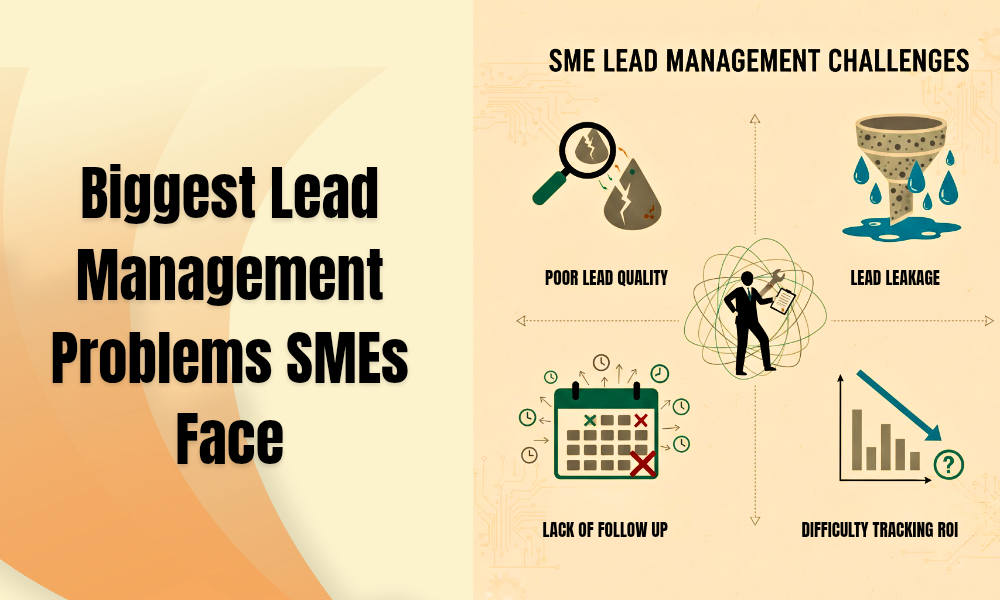
The Real Lead Management Crisis Inside SMEs (And Why Most Systems Fail)
Small and medium-sized enterprises (SMEs) do not struggle because they lack leads. In fact, most SMEs generate more leads than they can handle. The real issue lies in how those leads are managed, followed up, nurtured, and converted.
Over the years, SMEs have adopted more marketing channels than ever before — websites, paid ads, social media, chat, SMS, email, booking calendars, and third-party marketplaces. Each channel promises more visibility and more opportunities. Yet with every new channel comes complexity.
What starts as growth quickly turns into chaos.
This is the lead management crisis facing SMEs today.
The Hidden Cost of Poor Lead Management
When lead management systems are broken or fragmented, the cost goes far beyond missed sales. SMEs experience:
- Lost trust from prospects
- Inconsistent customer experiences
- Burned-out teams
- Unclear marketing ROI
- Revenue that never materializes
Most importantly, business owners lose control and visibility.
This section explores the core lead management problems SMEs face, why they persist, and why traditional tools and approaches fail to solve them.
Problem 1: Leads Are Everywhere — But Owned Nowhere
One of the most common and damaging problems SMEs face is lead fragmentation.
Leads arrive through:
- Website forms
- Facebook and Instagram ads
- Google Ads
- SMS and WhatsApp messages
- Phone calls
- Email inquiries
- Booking calendars
But instead of flowing into one centralized system, they end up scattered across:
- Email inboxes
- CRMs that aren’t fully responsive used
- Ad dashboards
- Spreadsheets
- Team members’ personal devices
There is no single source of truth.
Why This Happens
SMEs often add tools incrementally:
- One tool for ads
- Another for email
- Another for scheduling
- Another for CRM
Each tool works in isolation, creating data silos.
The Result
- Leads get missed
- Duplicate follow-ups happen
- No clear ownership of prospects
- Poor customer experience
Fragmentation kills momentum.
Problem 2: Slow Follow-Ups That Kill Conversion Rates
Speed is everything in lead management. Numerous studies show that contacting a lead within minutes — not hours — dramatically increases the likelihood of conversion.
Yet SMEs often:
- Respond manually
- Rely on reminders
- Miss leads outside business hours.
By the time a response goes out, the prospect has already moved on.
Why SMEs Struggle With Speed
- Limited staff
- Manual processes
- No automation strategy
- No after-hours coverage
The Result
- Leads go cold
- Marketing spend is wasted.
- Conversion rates plummet
This is not a people problem — it’s a system problem.
Problem 3: No Clear Lead Journey or Pipeline Visibility
Ask most SME owners:
- “Where are your leads right now?”
- “Which stage converts best?”
- “Where do leads drop off?”
Many cannot answer with confidence.
Common Issues
- No defined sales stages
- No visual pipeline
- No real-time tracking
- No performance benchmarks
Leads exist, but their journey is invisible.
Why This Is Dangerous
Without visibility:
- Sales forecasting is guesswork.
- Follow-ups are inconsistent
- High-value leads aren’t prioritized.
Growth becomes unpredictable.
Problem 4: Manual Work That Doesn’t Scale
In the early days, SMEs rely on manual effort:
- Sending emails
- Booking appointments
- Free Updating lead status
- Assigning tasks
This works — until it doesn’t.
As lead volume increases, manual processes collapse under their own weight.
The Hidden Costs
- Human error
- Missed follow-ups
- Inconsistent messaging
- Team burnout
Manual systems don’t just slow growth — they actively block it.
Problem 5: Poor Lead Nurturing (Or None at All)
Not every lead is ready to buy immediately. In fact, most are not.
Yet many SMEs:
- Follow up once or twice.
- Stop after no response.
- Send generic messages
There is no structured nurturing process.
Why Nurturing Fails
- No strategy
- No segmentation
- No automation
- No long-term view
Leads that could convert in weeks or months are abandoned.
Problem 6: Marketing and Sales Are Disconnected
In many SMEs, marketing and sales operate in silos.
Marketing focuses on:
- Generating leads
- Running campaigns
- Increasing traffic
Sales focuses on:
- Closing deals
- Following up manually
- Managing conversations
There is little alignment between the two.
The Impact
- Leads aren’t properly followed up on.
- Sales doesn’t know lead intent.
- Marketing can’t measure real ROI
Disconnected systems create disconnected experiences.
Problem 7: No Reliable Data or Reporting
SMEs often ask:
- Which channel works best?
- Which leads convert?
- Where should we invest more?
But without reliable data, decisions are based on assumptions.
Common Reporting Issues
- Data is spread across tools.
- Incomplete tracking
- No attribution clarity
This leads to wasted spend and slow optimization.
Problem 8: Inconsistent Customer Experience
Different leads receive different experiences depending on:
- Who responds
- When they respond
- Which channel is used
There is no consistency in tone, timing, or messaging.
Trust erodes quickly when experiences feel random.
Problem 9: Lack of Internal Expertise
Even when SMEs adopt advanced platforms, they often lack:
- Strategic setup knowledge
- Automation excellent design expertise
- Optimization experience
Tools are purchased — but never fully leveraged.
This is why many SMEs feel overwhelmed and underwhelmed at the same time.
Why Traditional Tools Fail SMEs
Most lead management tools were not built for SMEs:
- Too complex
- Too disconnected
- Too rigid
They require SMEs to adapt to the tool — instead of the tool adapting to the business.
This is where a unified platform changes everything.
Why a Unified Platform Matters
The solution to SME lead management problems isn’t “more tools” — it’s fewer, smarter systems.
This is where GoHighLevel stands apart.
GoHighLevel was designed to centralize, automate, and scale lead management — but its true power lies in how it is implemented.
Centralized Lead Capture & CRM
GoHighLevel consolidates:
- Website leads
- Paid ad leads
- Calls
- Messages
- Appointments
Into one centralized CRM.
No more fragmentation. No more guessing.
When implemented through professional gohighlevel services, the CRM is customized to reflect:
- Your business model
- Your sales stages
- Your customer journey
This creates clarity and control.
Instant, Automated Follow-Up at Scale
GoHighLevel enables:
- Immediate SMS responses
- Automated email replies
- Voicemail drops
- Multi-step follow-ups
Every lead is contacted instantly — even outside business hours.
This is one of the biggest reasons SMEs choose to Hire gohighlevel experts:
Automation must be fast and strategic.
Visual Pipelines That Drive Action
With GoHighLevel, SMEs get:
- Custom pipelines
- Drag-and-drop deal tracking
- Stage-based automation
Sales teams always know:
- What to do
- Who to follow up with
- Which leads matter most
This transforms chaos into momentum.
Automation That Replaces Manual Work
GoHighLevel workflows automate:
- Appointment booking
- Task assignments
- Follow-ups
- Notifications
But automation without strategy is dangerous.
Experienced gohighlevel experts design workflows that:
- Reduce friction
- Improve experience
- Scale sustainably
Advanced Lead Nurturing That Converts
GoHighLevel enables:
- Long-term nurturing
- Behavior-based follow-ups
- Personalized messaging
Leads are educated, warmed, and guided — not pressured.
This dramatically improves lifetime value
Marketing & Sales Alignment in One System
GoHighLevel unifies:
- Marketing automation
- CRM
- Sales communication
Every action feeds the same system.
Marketing generates better leads.
Sales close faster.
Data, Reporting & Real Insights
With GoHighLevel, SMEs gain:
- Source attribution
- Conversion tracking
- Funnel performance data
When delivered via expert GoHighLevel services, reporting focuses on:
- Revenue impact
- ROI
- Growth decisions
Not vanity metrics.
Consistent, Trust-Building Customer Experience
Automation ensures:
- Consistent tone
- Timely responses
- Professional communication
- Trust drives conversions
Why Hiring GoHighLevel Experts Makes a Difference
GoHighLevel is powerful — but not self-explanatory.
SMEs that Hire gohighlevel experts benefit from:
- Proven frameworks
- Clean system architecture
- Faster ROI
- Ongoing optimization
This turns software into a growth engine.
From Lead Chaos to Predictable Growth
SME lead management problems are not inevitable — they are solvable
With the right platform and the right expertise, SMEs can:
- Centralize leads
- Respond faster
- Nurture better
- Convert more
GoHighLevel, when paired with professional gohighlevel services, transforms lead management from a daily struggle into a competitive advantage.
Growth becomes predictable.
Systems become scalable.
Leads finally work for the business — not against it.
Implementing GoHighLevel the Right Way — From Software Adoption to Scalable Growth Engine
Why Most SMEs Fail Even After Choosing the Right Platform
By the time most SMEs discover GoHighLevel, they already understand one truth: their lead management systems are broken. They know they need automation, centralization, and visibility. They invest in the platform with high expectations.
Yet many businesses still fail to see meaningful results.
This is not because GoHighLevel lacks capability — it’s because software alone does not create transformation. Implementation, strategy, and ongoing optimization determine success.
In this section, we explore how SMEs can move from owning GoHighLevel to actually leveraging it as a long-term growth engine.
The Difference Between “Using” GoHighLevel and “Building on” GoHighLevel
There is a critical distinction most SMEs underestimate.
- Using GoHighLevel means logging in, sending messages, and creating basic pipelines.
- Building on GoHighLevel means designing a system that supports growth, adapts to change, and scales without chaos.
Most SMEs stop at usage.
Businesses that succeed treat GoHighLevel as infrastructure, not just software.
This mindset shift is where real value begins.
Step 1: Designing a Lead Management Architecture (Not Just a CRM)
High-performing SMEs start by answering fundamental questions:
- What does a qualified lead look like?
- What stages does a lead move through?
- When should automation assist — and when should humans step in?
- How do different channels behave differently?
Without answering these, automation becomes noise.
Professional gohighlevel services focus first on architecture:
- Logical pipelines
- Clear stage definitions
- Ownership rules
- Clean data flow
This foundation prevents system decay over time.
Step 2: Structuring Pipelines for Real Sales Behavior
Many SMEs create pipelines that look good on paper but fail in reality.
Common mistakes include:
- Too many stages
- Vague stage definitions
- No automation tied to stages
- No accountability
Effective GoHighLevel pipelines:
- Reflect real buying behavior.
- Trigger actions automatically
- Provide instant clarity to sales teams.
Experienced gohighlevel experts design pipelines that drive behavior, not just track it.
Step 3: Automating Responsibly (More Automation Is Not Always Better)
Automation is powerful — but dangerous when misused.
Over-automation leads to:
- Robotic communication
- Message fatigue
- Trust erosion
Under-automation leads to:
- Missed follow-ups
- Human error
- Slow response times
The balance lies in intentional automation.
High-performing SMEs user friendly GoHighLevel to:
- Automate speed and consistency
- Preserve human tone and judgment.
- Adapt messaging based on behavior.
This balance is rarely achieved without expert guidance.
Step 4: Building Follow-Up Systems That Adapt to Lead Behavior
Not all leads behave the same way:
- Some reply immediately
- Some browse silently
- Some disappear and return weeks later.
Static follow-up sequences fail because they assume uniform behavior.
Advanced GoHighLevel setups:
- Adjust follow-ups based on engagement.
- Pause automation when humans intervene.
- Resume intelligently when needed.
This adaptive approach significantly increases conversions — and protects brand trust.
Step 5: Turning Lead Data Into Decision-Making Power
Most SMEs collect data but don’t use it.
GoHighLevel provides access to:
- Lead source performance
- Stage conversion rates
- Follow-up effectiveness
- Time-to-close metrics
The problem isn’t access — it’s interpretation.
Professional gohighlevel services transform raw data into:
- Actionable dashboards
- Clear KPIs
- Decision frameworks
This is where SMEs move from reactive to strategic.
Step 6: Aligning Teams Around One System of Truth
As SMEs grow, misalignment becomes expensive.
Sales blames marketing.
Marketing blames lead quality.
Operations struggle with visibility.
GoHighLevel eliminates this by becoming:
- The shared CRM
- The communication hub
- The reporting source
When everyone works from the same system, friction drops, and accountability rises.
Step 7: Scaling Without Breaking Systems
Growth exposes weaknesses.
What works at 50 leads per month often fails at 500.
Scalable GoHighLevel systems:
- Use modular workflows
- Separate logic cleanly
- Avoid hard-coded assumptions
- Allow expansion without rework.
This is where businesses that Hire gohighlevel experts gain a long-term advantage — systems are built for tomorrow, not just today.
Step 8: Preventing System Decay Over Time
One of the most overlooked risks in automation is system decay.
Over time:
- Workflows stack
- Logic overlaps
- Messaging conflicts
- Performance drops
Without maintenance, even great systems fail.
Ongoing optimization ensures:
- Clean automation
- Updated messaging
- Aligned strategy
This is why leading SMEs treat GoHighLevel as a living system, not a one-time setup.
Step 9: Trust, Compliance, and Responsible Communication
Modern lead management requires responsibility.
SMEs must consider:
- Consent
- Frequency
- Message relevance
- Data hygiene
GoHighLevel supports responsible communication — but only when configured correctly.
Trust is not built through volume.
It is built through relevance and respect.
Step 10: From Lead Management to Revenue Operations
The most mature SMEs evolve beyond “lead management.”
They build revenue operations:
- Unified lead flow
- Automated engagement
- Sales intelligence
- Performance measurement
GoHighLevel becomes the operational backbone.
This shift transforms growth from unpredictable to systematic.
Why Expertise Accelerates Results
SMEs that attempt to “figure it out later” often lose:
- Time
- Leads
- Momentum
Those who hire gohighlevel experts benefit from:
- Proven frameworks
- Faster implementation
- Fewer mistakes
- Higher ROI
Expertise compresses learning curves — and protects growth.
GoHighLevel as a Competitive Advantage
Lead management is no longer optional — it is a competitive differentiator.
SMEs that master it:
- Respond faster
- Convert more
- Build stronger trust
- Scale sustainably
GoHighLevel provides the platform.
Gohighlevel services provide the execution.
Gohighlevel experts provide the strategy.
Together, they turn complexity into clarity—and drive long-term revenue.